Shamiran Istifan
Manor Art Prize 2026
In her introductory text to the exhibition catalogue, curator Sarah Mühlebach traces the threads of thought that run through the works of Shamiran Istifan,
By the way, we’re just a window on the world
 i
i
Manor Kunstpreis 2026
12.6.–6.9.2026, Aargauer Kunsthaus
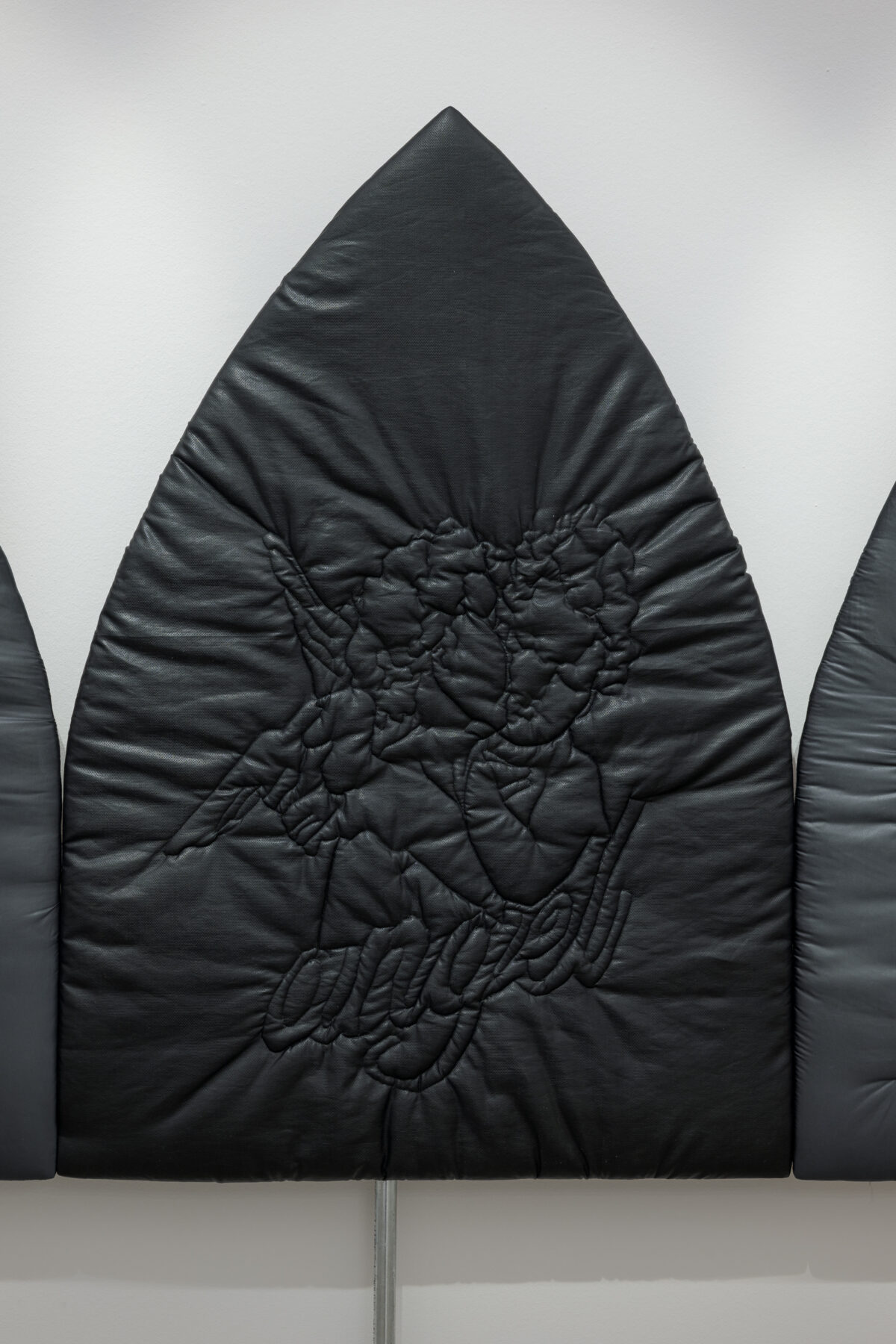
Shamiran Istifan, Unearth Angel I-VII [Detail], 2026
Foto: ullmann.photography
«By the way, we’re just a window on the world.» This is one of the poetic thoughts offered by the Lebanese-American author and artist Etel Adnan in her text Night (Etel Adnan, Night, Nightboat Books, New York, 2016, p. 17). In this sentence, both the narrator and we, the readers, become a window. One of many windows that look out onto the world. We don’t become a structure that fills a site or occupies a territory, but a pane of glass – transparent and protective but also fragile.
Windows form a threshold between public and private space, separate inside from outside, shield us from prying eyes and protect the domestic sphere. This is an architectural element in which intimacy and openness intertwine. At the same time, however, windows are translucent membranes; we can see through them. And from behind the pane of glass we can (stealthily) observe the (sub)urban realm, the hectic hustle and bustle of an old town centre or the blossom bursting from a tree in the backyard. Windows are also mirrors. They reflect the light and the outside world, but also the interior in which we find ourselves at any moment, or even our own reflection. Ultimately, however, windows only present us with a fragmentary view of a reality and a living environment – an image framed by the individual perspectives of the observers.
 i
i
Manor Kunstpreis 2026
12.6.–6.9.2026, Aargauer Kunsthaus
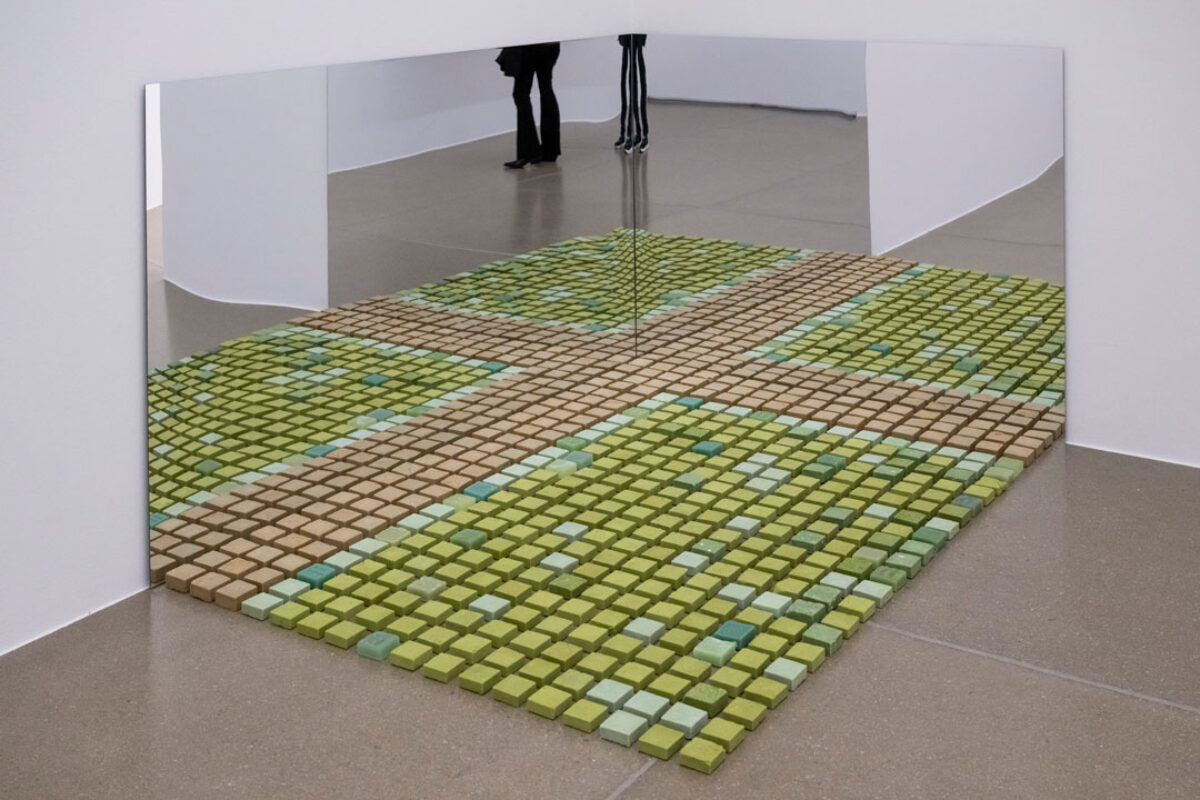
Shamiran Istifan, Diva Nation [Detail], 2026
Foto: Alex Spichale, Baden
When I look at Shamiran Istifan’s sculptures, (video) installations and textile works, I am inevitably thrown back upon myself. Silhouettes of my body or the gently distorted reflection of my face are mirrored by their shiny surfaces, as exemplified by the Plexiglas of the work Chiasms in the Flood Narrative (2022). Inspired by the story of the biblical flood, the artist has engraved fragments of poetry in the transparent material. In the right lighting conditions, the ornate script can be legible, but it can also merge at any moment back into the transparency of the Plexiglas. Surfaces also play a central role in other works by Shamiran Istifan – as projection screens, but also as symbols of control or desire. From time to time, silvery textures, black or skin-coloured imitation leather, shimmering elements and reflections lend the works a mystic aura.
 i
i
Manor Kunstpreis 2026
12.6.–6.9.2026, Aargauer Kunsthaus
Shamiran Istifan,
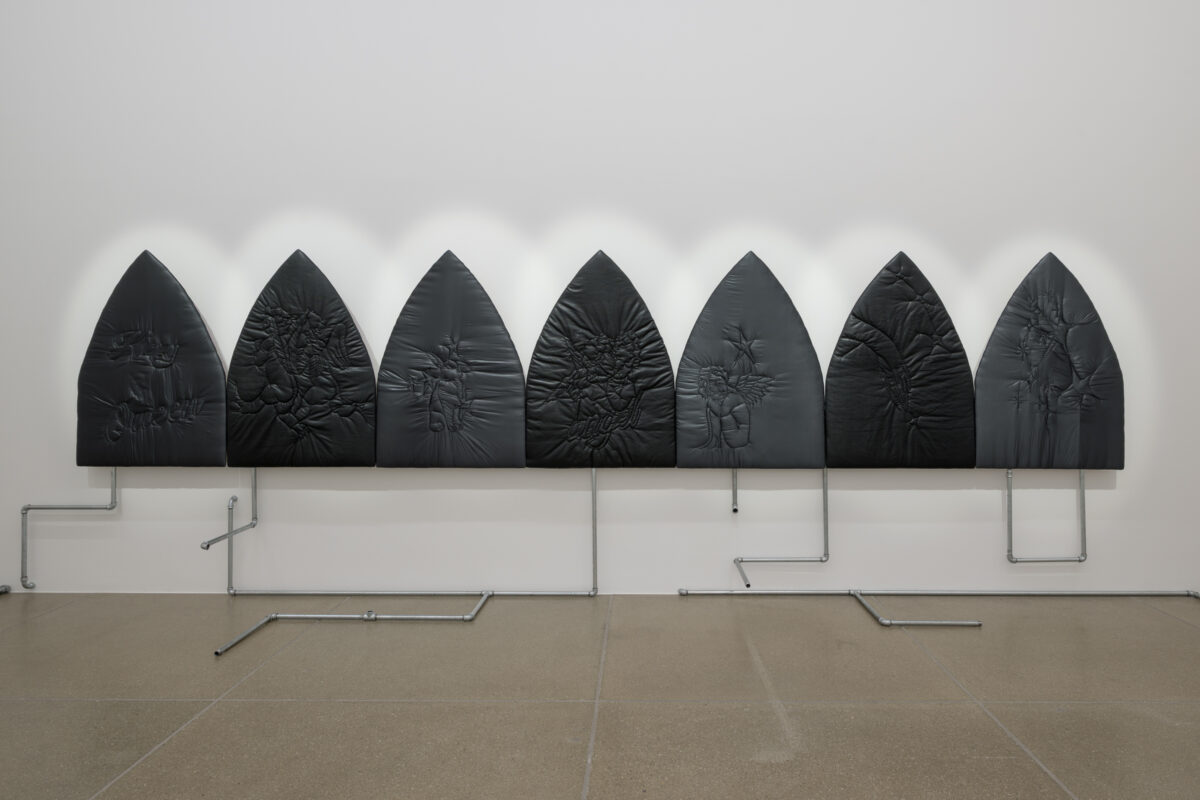
Unearth Angel I-VII, 2026
Pipelines, 2026
Foto: ullmann.photography
In her art, Shamiran Istifan plays with visual codes that penetrate our everyday (public) lives, but also with references to a world that is associated with her personal experience of a diaspora. The importance of this imagery, which is anchored in such specific contexts as the geocultural reality of Switzerland’s Assyrian community, sometimes escapes me – as a woman who was socialised in Central Switzerland and lives in Zurich – at first glance. This suggests that it would be easy for me to lapse into cultural voyeurism, and yet, upon closer inspection, many elements seem more familiar than expected: washbasins, angels, letter boxes, paving stones, etc. The artist is permanently seeking to refer to a range of times, contexts and living environments, which she then combines and abstracts. She employs this level of abstraction as a means of enabling us to experience the complexity of social cohabitation: a complexity that, in particular, reflects the lived reality of many members of diaspora communities, who switch smoothly between different worlds in their everyday lives. And perhaps the collage-like combination of motifs from cultural-historical and religious contexts, from social media and popular culture, is symptomatic of our deeply digital age: everything happens simultaneously; the offline and online worlds are relentlessly becoming one.
Even if it is more symbolic than formal, the window analogy could offer us our first means of approaching the artistic methods of Shamiran Istifan. Positioned between everyday reality and a gateway to imaginary transcendental spheres, the works of the artist describe threshold situations: between inside and outside, visibility and invisibility, private and public, accessibility and exclusion, and between parallel existences. Two lines of poetry from the aforementioned work on Plexiglas vividly express this moment of transition: «The window of the heavens is open» and «The window of the heavens is closed». The two sentences also generate a formal mirrored movement in the work that recalls the rhetorical inversion that is common to the chiasmus. This gesture of opening and closing resonates here – and in the work of Shamiran Istifan more generally – with the question of who has access to spaces, who is prevented from entering them and who can only dream thereof.
 i
i
Manor Kunstpreis 2026
12.6.–6.9.2026, Aargauer Kunsthaus
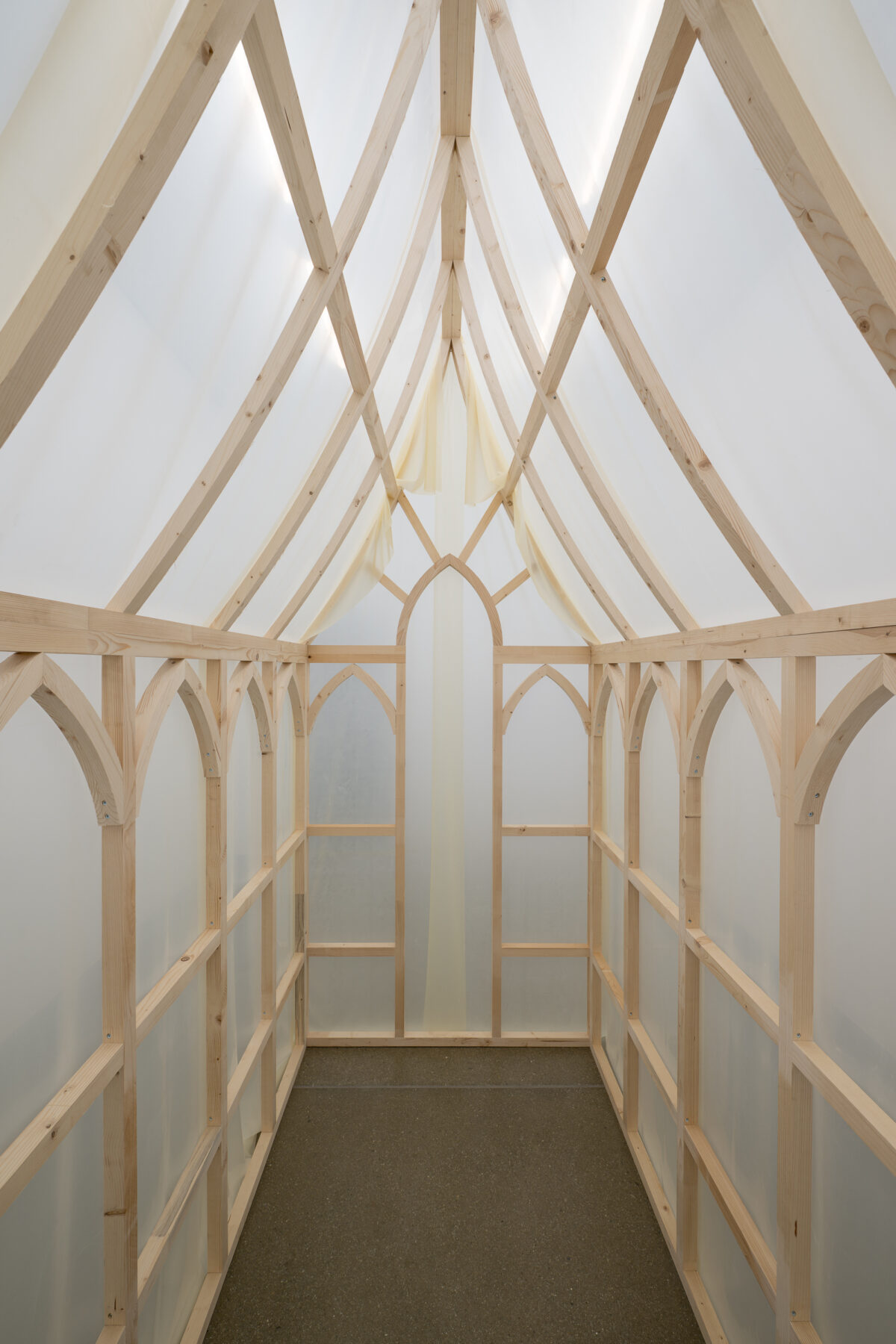
Shamiran Istifan, Skin City, 2026
Foto: ullmann.photography
Recalling spaces, conquering spaces
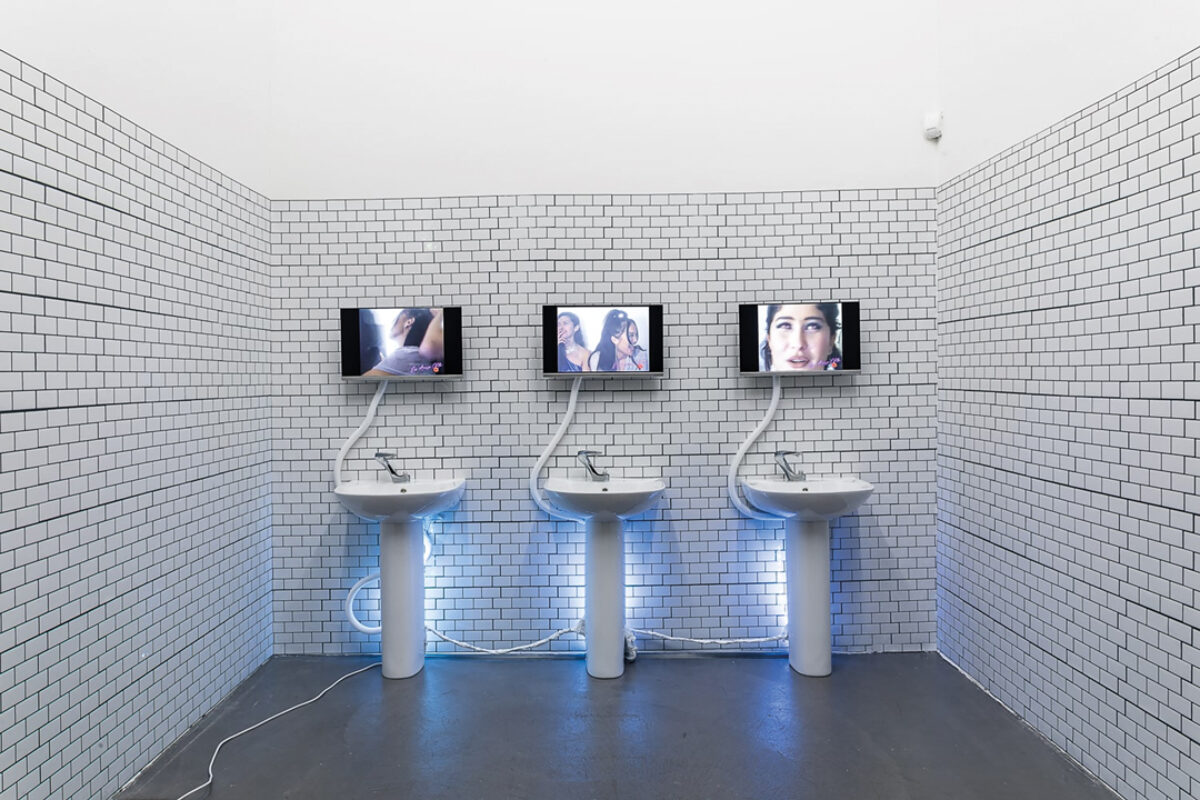
The installation Ex Amore Vita: Ladies’ Room (2021) consists of a recreation of a ladies toilet with three washbasins. Fake tiles create the illusion of a public lavatory within the space of the museum – an enclave in the enclave – that is immediately exposed: the mirror is replaced by video screens that show a group of women. They find themselves in a similar bathroom setting, where they are chatting animatedly, smoking and dancing, putting on make-up and doing their hair. The camera sweeps through the room accompanied by the music of a waltz, capturing details such as jewellery, make-up brushes, cigarette ash in the washbasin, or the familiar yet determined gesture of the energetic lacing up glistening evening gown. Images and scenes alternate like fragmented memories of fleeting moments. The slightly shaking camera plays knowingly with the aesthetic of the poor image. The video installation draws on the aesthetic of weddings in diaspora communities in the early 2000s, like the ones the artist experienced as a teenager: «I actually made the video through the eyes of myself as a young girl, when I went to the lavatory and experienced the aunts and mothers in all their femininity, and right up close.» ( See interview with Shamiran Istifan in Vera Lang, ‘Geteilte Erfahrungen im Badezimmer: Die Installationen von Judy Chicago und Shamiran Istifan’, Bachelor diss., University of Zurich, 2023, quotation translated by R. H.)
 i
i
Videoinstallation (Bildschirme, weiche Fliesen, Keramikwaschbecken, LED, Ton, verschiedene Materialien), 400 x 300 cm
Installationsansicht Werkschau
30.9. – 10.10.2021, Haus Konstruktiv, Zürich
Mit Genehmigung der Künstlerin
© Shamiran Istifan
In the video, Shamiran Istifan recreates a microcosmos – a gender-specific safe space that can be found, covertly, at weddings – which women appropriate in order to come together and relax for a moment, free of the presence of men. By doing this, she illustrates issues of spatial politics and accentuates a form of exaggerated, performative femininity – hyperfeminity as a strategy of self-empowerment within patriarchal structures. The protagonists in the video are friends and artist acquaintances with similar social and cultural backgrounds. As a result, the work celebrates the mutual support and the bond between these women, who have gained access to (elite) spaces within a relatively homogenous, competitive and still male-dominated artistic milieu.
Shamiran Istifan regularly employs (interior) spaces as reflecting lenses in her artistic practice as a way of addressing broader social issues. In Micro Entities (2020), her first solo exhibition, she was already working with re-enactment in her recreation of a community space. Due to strict anti-COVID measures, the opening took place in a digital space, via CCTV images (that were livestreamed on YouTube), which lent the work yet another socio-political dimension: the meeting point for a specific community could suddenly be experienced by the public, and was even transformed by the cameras into a voyeuristic object, while the people who usually met there remained absent. In the exhibition Micro Entities, as in Ex Amore Vita: Ladies’ Room, the artist is creating lasting images that recount the history of a community that is generally only handed down by word of mouth.
In the group exhibition Demanding, Yet Gentle, which she co-curated in the former restaurant of the Kunsthaus Zürich as part of the ‘Clubhaus’ collective in 2023, Shamiran Istifan once again based her contribution on Assyrian collective spaces. She designed a form of stage set that took on the atmosphere of these provisional, repurposed spaces, which are often found in industrial surroundings: white light, grey carpet, tables that are prepared for people to play cards. Carefully positioned works by invited artists became the protagonists of this production. The socially suggestive scenography occupied, temporarily and symbolically, the elite structure of the museum. The role played by diversity in institutions is critically addressed by the British author, researcher and feminist activist of colour Sara Ahmed, who aptly describes the experience of becoming alien: «We can think from the experience of becoming a stranger. A stranger experience can be an experience of becoming noticeable, of not passing through or passing by, of being stopped or being held up. A stranger experience can teach us about how bodies come to feel at home through the work of inhabitance, how bodies can extend themselves into spaces creating contours of inhabitable space, as well as how spaces can be extensions of bodies.» (Sara Ahmed, On Being Included, Racism and Diversity in Institutional Life, Duke University Press, Durham and London, 2012, p. 3.) While regarding spaces as extensions of bodies, Ahmed considers that they cannot be neutral because structural power relations affect both the spaces and the bodies that occupy them. As a critical commentary on (in)visibility, access and systemic exclusion, Shamiran Istifan’s exhibition and scenographic intervention represented a demanding, yet gentle call to address spaces differently, to occupy them and to fill them with new narratives.
 i
i
Satellitenschüssel aus Aluminium, Aufkleber, Epoxidharz
Foto: Konkord Photography (Lorenzo Merlanti, Maciej Czepiel)
Objekte des Dazwischen
Finally, the work Teleportation Loop Player (2019) took as its starting point an object that, while existing in the public realm, refers to a private, domestic space. In Europe, the satellite dish on a roof or facade is regarded as an involuntary indicator of the presence of a migrant household. It enables the inhabitants to access media from their country of origin, to watch the news or series or listen to music. In this sense, the object also symbolises the self-determined preservation of one’s own cultural perspectives, while embodying a moment of resistance. Shamiran Istifan often uses images, symbols and materials in her art, which she then overlays, tongue in cheek, with new, sometimes sacred significance. For example, she transforms the satellite dish into a sculpture that shimmers like an over-dimensioned shell, while also giving it yet another layer of meaning: by covering it with a pattern resembling that of the luxury brand Louis Vuitton, she hints at the longing for social advancement that accompanies the carrying of Louis Vuitton bags. By adding two dots to the logo, the artist transforms it into the word ‘bana’: ن (bāna / bayn) comes from the ancient Semitic root B-Y-N, which is associated in Arabic and Aramaic with ‘separation’, ‘in-between’ and also ‘becoming clear’: something becomes clear or visible when one demarcates it or separates it. In this sense, the work symbolises growing up in a Teleportation Loop, in which constant invisible codeswitching and shapeshifting becomes an automatic practice that is defined by one’s social milieu: the adaptation of one’s language, clothing and behaviour – habitus in the Bourdieuesque sense (See, for example, Pierre Bourdieu, Distinction, Harvard University Press, Cambridge MA, 1984, (originally published as Pierre Bourdieu, La distinction, Les Éditions de Minuit, Paris, 1979)) – as a means of not standing out through demarcation or separation. In her short literary text «ALL YOU GET BACK IS THAT FLUORIDE STARE», Shamiran Istifan describes the art of adapting as an ultimative skill: «I have almost no skills, except adapting, which is after all the ultimative skill because one has to get used to the temporary, to flexibility. I’m a shapeshifter and I got what you want in my silly little store, just tell me what would keep you entertained.» (Text written to accompany the exhibition Emmy Hennings / Sitara Abuzar Ghaznawi in the Swiss Institute New York, see Emmy Hennings / Sitara Abuzar Ghaznawi, ed. Simon Castets and Salome Hohl, Swiss Institute with Lenz Press, New York, 2022)
 i
i
Manor Kunstpreis 2026
12.6.–6.9.2026, Aargauer Kunsthaus
Shamiran Istifan, Inbox, 2026
Foto: ullmann.photography
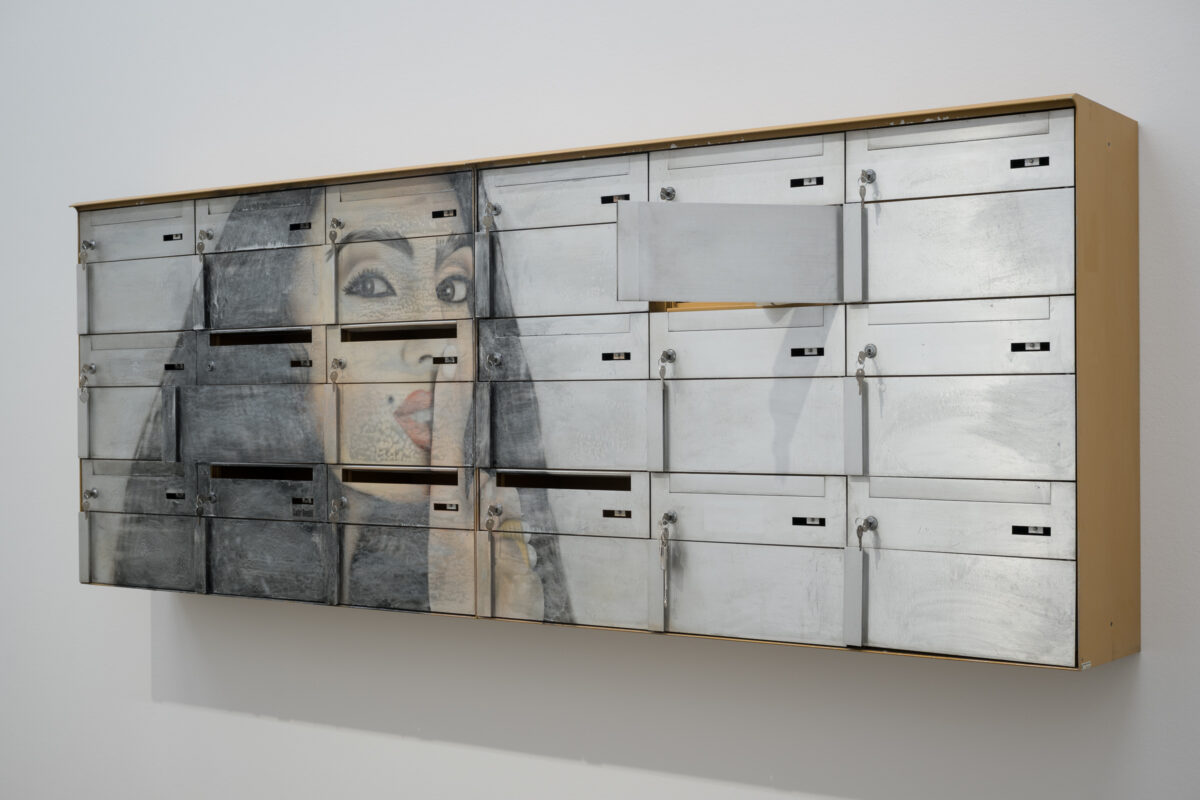
For her first institutional exhibition in the Aargauer Kunsthaus, which also represents a return to the region in which she grew up, Shamiran Istifan is once again addressing a specific object that exemplifies the interface between private and public space: the letter box. The artist transfers the typical Swiss design object to the wall of the museum, into the institutional context. The work Inbox (2026) consists of letter boxes, whose repetitive, geometrical structures suggest a minimalist sculpture. But the face of a woman applied to the metallic surface by means of layers of paint and make-up breaks with the bureaucratic and standardised formal language of the letter box. It is the Lebanese singer and actor Haifa Wehbe, one of the most successful Arabic-speaking pop stars of the 2000s, who is staring straight back at us, holding a finger to her lips. Due to its association with innocence and with discretion and the non-disclosure of confidential information, this is a gesture full of subversive potential. The work combines references to youth culture, the advertising industry and street art, a form of appropriating public space, with the transition to private, often hidden narratives. And the work also touches on the issue of how bureaucratic processes affect and restrain bodies and bring inequalities to light. The artist addresses the letter box as an architectural object that contains untold personal stories, while also pointing to overarching, collective systems and power relations. Her art deals with the intertwining of space and body in a manner that is both poetic and highly precise and turns our attention from the individual to the broader structural context.
Text: Sarah Mühlebach, Curator Shamiran Istifan. Manor Art Prize 2026