Flowers to Art 26
The success story of combining floristry and art continues to captivate guests in the twelfth iteration of Flowers to Art. Intricate installations above a humming fan, and fragrant mimosas set against abstract paintings are but a few of the masterpieces presented by floral designers from across Switzerland – and an international guest from Berlin brought fresh perspectives to this year’s exhibition.
Guido Nussbaum + Kathrin Muggli
 i
i
3.3.–8.3.2026, Aargauer Kunsthaus
Florale Interpretation: Kathrin Muggli, Hinwil
Werk: Guido Nussbaum, Mikrophon, 1986
Aargauer Kunsthaus / Ankauf, 2000
Foto: David Aebi, Burgdorf
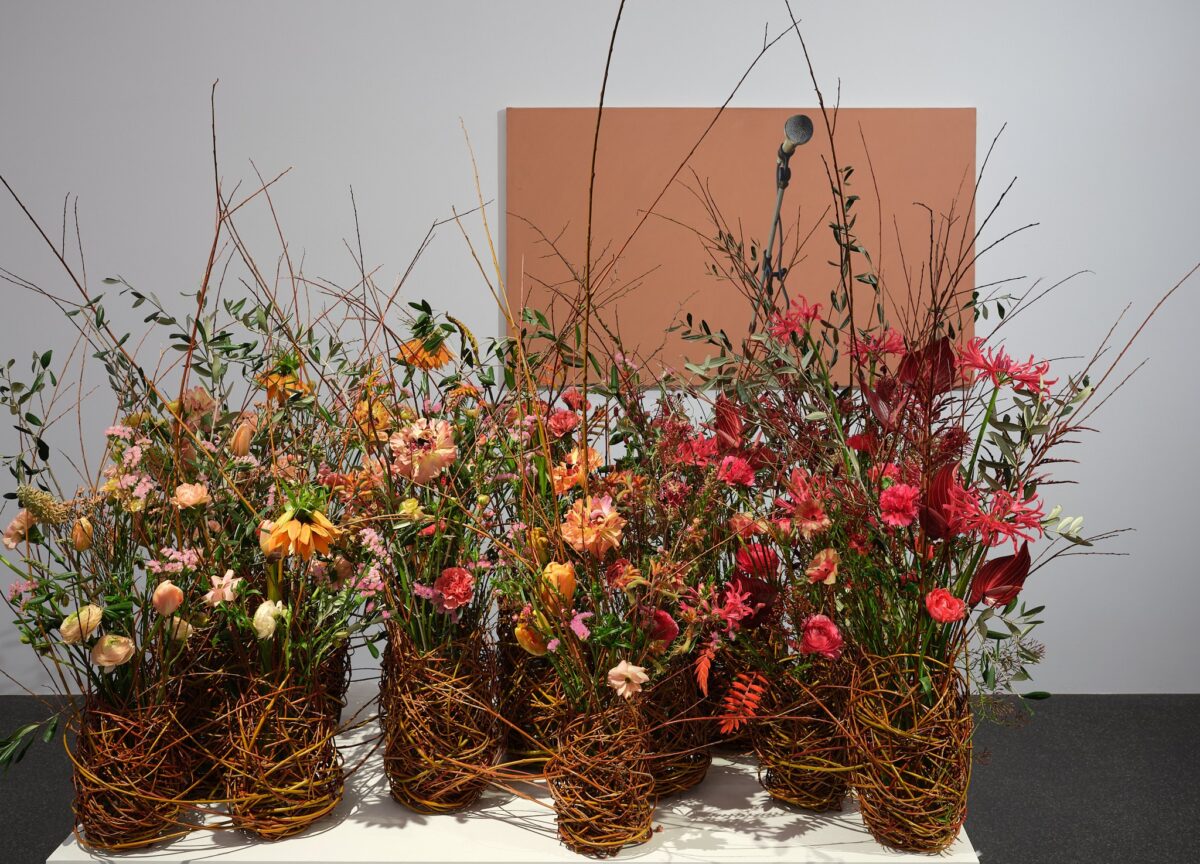
Born in Muri and now based in Basel, artist Guido Nussbaum pursues a conceptual approach. His works deal with, among other things, the perception and categorisation of different art genres, blurring their boundaries in the process. In Microphone, the playful use of media is combined with a (self-)reflection on the figure of the artist and art itself. Guido Nussbaum uses the motif of the microphone to create a kind of portrait, but without actually depicting anyone. The merely suggested presence of a person invites reflection on the role of the painter, the viewer and the image. Is it the artist’s task to speak into the microphone himself and express himself through his art? Or does the work rather challenge viewers to make their voices heard?
Kathrin Muggli directly incorporated Guido Nussbaum’s Microphone: simple yet questioning, it is present in the room. It encourages people to take a stand and express themselves. The florist does not see her own voice as a dominant element, but rather as part of a polyphony. She twists organic forms from willow branches, reminiscent of interwoven bodies. The result is a floral structure that bundles, amplifies and connects voices. The floral work translates the motif of the microphone into an open resonance chamber: choir, protest or applause remain open to interpretation. Viewers are invited to imagine their own voice within this polyphonic whole.
Barbara Müller + Rémy Jaggi
 i
i
3.3.–8.3.2026, Aargauer Kunsthaus
Florale Interpretation: Rémy Jaggi, Trélex
Werk: Barbara Müller, Ohne Titel, 2015
Nachlass Barbara Müller
Foto: David Aebi
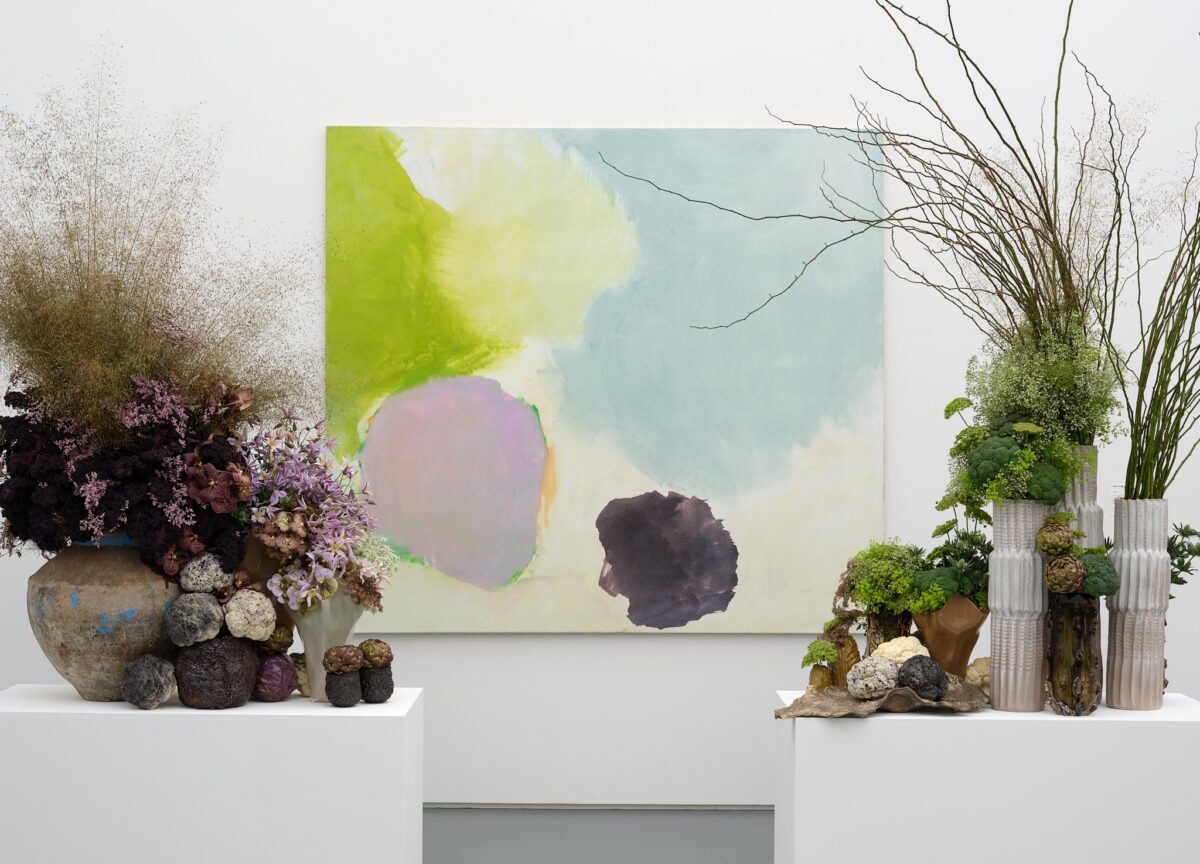
Barbara Müller says: ‘I like it when colours clash, strokes run counter to each other and a filled surface is broken up by a glaze.’ Untitled features delicate, multi-layered, interflowing and yet powerful cloud-like areas of colour. Barbara Müller’s paintings are the result of long creative processes and intense concentration. The artist sometimes works on a painting for over a year and only considers it finished when a deep inner tension is released.
Rémy Jaggi’s floral interpretation follows the inner movement of Barbara Müller’s work in a clear sequence: the starting point is a dark area that evokes earth, roots or winter for Jaggi. Coloured cauliflower, kale and artichokes intensify this origin. From there, the composition develops upwards and to the left: buds and blossoms appear in shades of purple through clematis, Vanda orchids and unfolding kale leaves, which take up the layering of the painting. Grasses, limonium and gypsophila translate the cloud-like lightness of the colour fields. On the right-hand side, the movement is mirrored and completed: lady’s mantle, wild carrot, rose branches, eringium and delicate green connect heaven and earth and close the vegetative cycle. As in the picture, the effect and intensity change depending on the angle of view.
Jean Pfaff + Nicolaus Peters
 i
i
3.3.–8.3.2026, Aargauer Kunsthaus
Florale Interpretation: Nicolaus Peters, Berlin (DE)
Werk: Jean Pfaff, Spaltkasten, 1974
Aargauer Kunsthaus / Ankauf, 1978
© 2026, ProLitteris, Zürich
Foto: David Aebi, Burgdorf
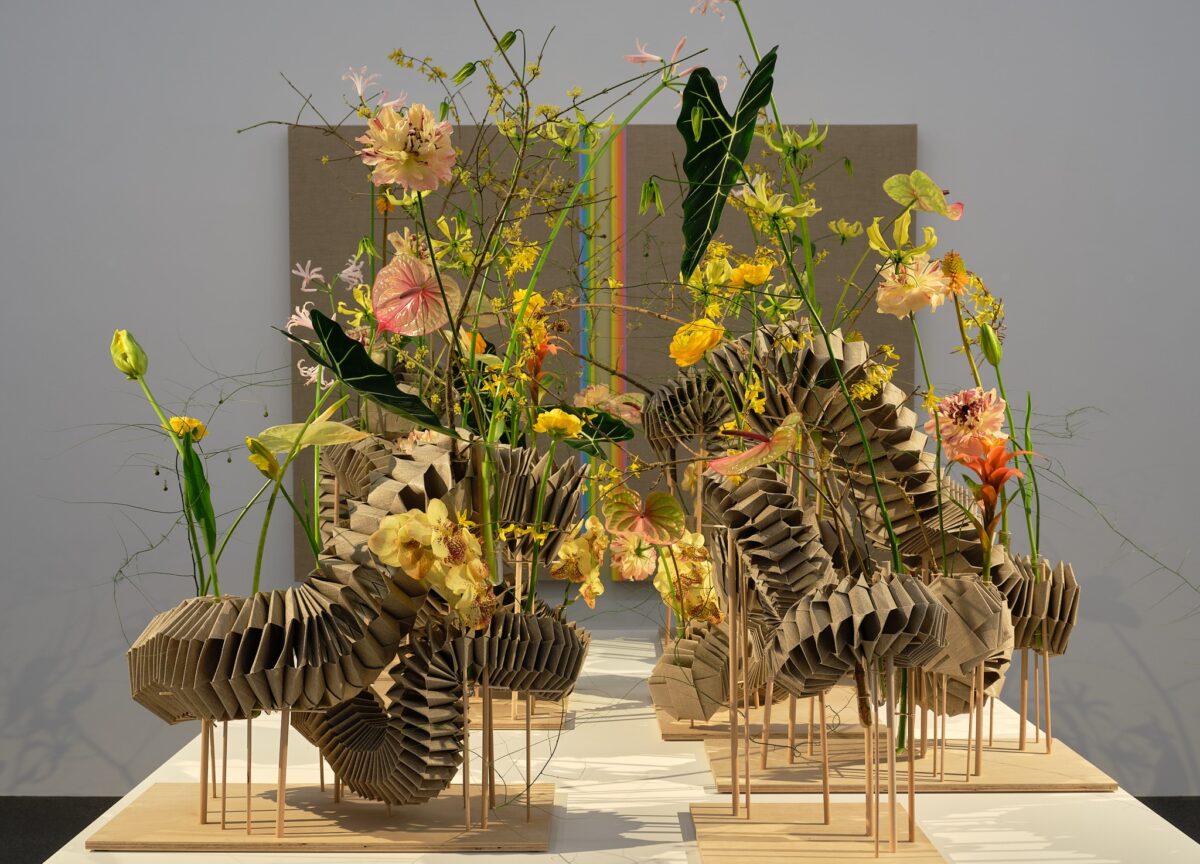
Basel artist Jean Pfaff explores the perception of colour and form in his work. The artist’s early interest in colour theory is reflected in Spaltkasten. The diptych consists of two equally sized, unfinished canvases, in the centre of which the colour spectrum splits into thin strips painted with acrylic. The arrangement of the spectral colours appears on the canvas as if a colour wheel had been separated and fanned out at the violet and yellow ends. While the violet frames the entire spectrum, the luminosity of the yellow colour in the centre is so strong that the eye reconnects the broken spectrum at this point and the gap between the two images almost disappears.
Nicolaus Peters approaches Jean Pfaff’s Spaltkasten through the materiality of the untreated canvas. This element forms the supporting framework of his floral interpretation. Using the Japanese folding technique kirigami, the two-dimensional surface is transformed into an unfolded, three-dimensional object. Peters deliberately emphasises the division of the artwork into two parts: a clearly defined split draws the eye into the depths. In terms of colour, the floral design responds to the luminosity of the dominant yellow in the centre of the work. Anthuriums, oncidiums, ranunculus, craspedia and gloriosa seem to float above the structure, while pink and rose-coloured nerines subtly expand the colour harmony and accentuate the tension between separation and visual connection.
Richard Paul Lohse + Peter Schwitter
 i
i
3.3.–8.3.2026, Aargauer Kunsthaus
Florale Interpretation: Peter Schwitter, Buochs
Werk: Richard Paul Lohse, Reihenelemente zu rhythmischen Gruppen konzentriert, 1946 / 1956
Aargauer Kunsthaus / Schenkung der Freunde der Aargauischen Kunstsammlung, 1984
© 2026, ProLitteris, Zürich
Foto: David Aebi, Burgdorf
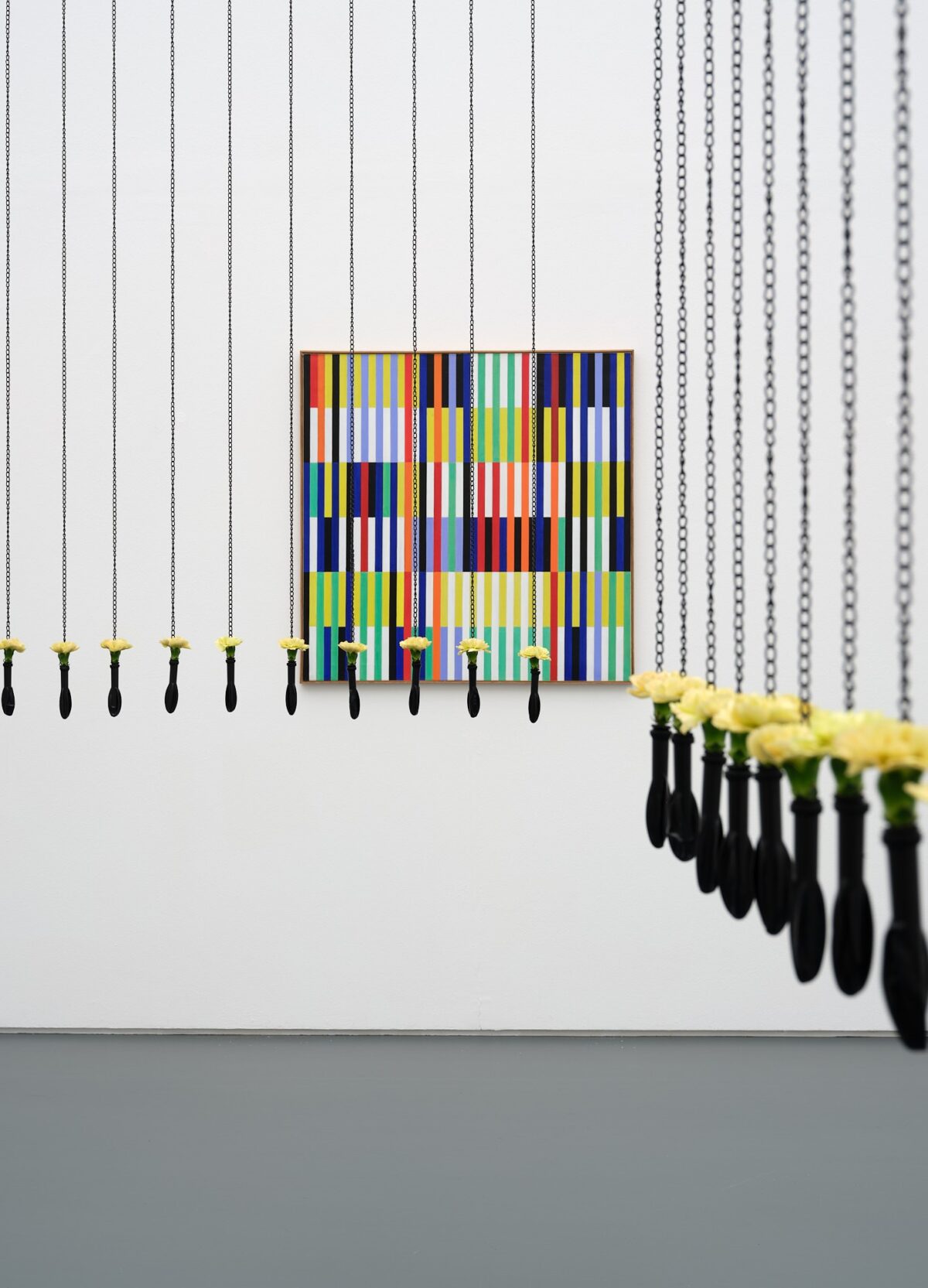
From the mid-1930s onwards, Richard Paul Lohse was part of the core group of Zurich Concrete artists and, together with other artists, founded constructive concrete art. His paintings, consisting of many equivalent geometric shapes, are based on complex theoretical considerations and laws. The title of the painting, Series Elements Concentrated into Rhythmic Groups, gives viewers a clue to the principles that form its basis. The composition consists of vertical stripes, each distinguished from the others only by their colour. They are arranged in rhythmic and colourful sequences that are partly repetitive but also change, creating the impression of multiple shifting and shimmering image planes.
Peter Schwitters’ floral interpretation draws on the strict order of Richard Paul Lohse’s work. Rhythms, colours and groupings repeatedly attract the viewer’s gaze. Schwitters takes up the clearly defined, almost restrained colours in the picture and translates this tension with black chains as a symbol of order and limitation. At the same time, one colour – in the form of carnations – breaks up the structure. At first, the carnations appear evenly spaced in the space, in keeping with the rhythm of the picture. As the picture progresses, they increasingly break free from this order with the help of a tension spring and find their own rhythm. The colour becomes free, spreads out in the space and refers to the constant change that is ultimately inherent in every system.
Joseph Marioni + Samantha Bühler
 i
i
3.3.–8.3.2026, Aargauer Kunsthaus
Florale Interpretation: Samantha Bühler, Winterthur
Werk: Joseph Marioni, Yellow painting, 2002
Aargauer Kunsthaus / Schenkung Joseph Marioni in Erinnerung an Bernhard Stahel, 2003
Foto: David Aebi, Burgdorf
Joseph Marioni is part of the Radical Painting Group, founded in the United States in the 1970s, which seeks new forms of expression through painting. He is particularly interested in the immaterial and sensory aspects of colour, i.e. its perception and effect in relation to space and light. Not only the choice of colour and painting technique, but also the size and format of the picture carrier play a role in his works. For the bright, open yellow of Yellow painting, for example, he chooses a large-format canvas. On it, he transfers colour sequences previously tested on glass, layer by layer, allowing the paint to flow downwards in a controlled manner. While the different layers remain visible, the result is a ‘colour portrait’ whose radiance illuminates the room like a light source and changes its atmosphere.
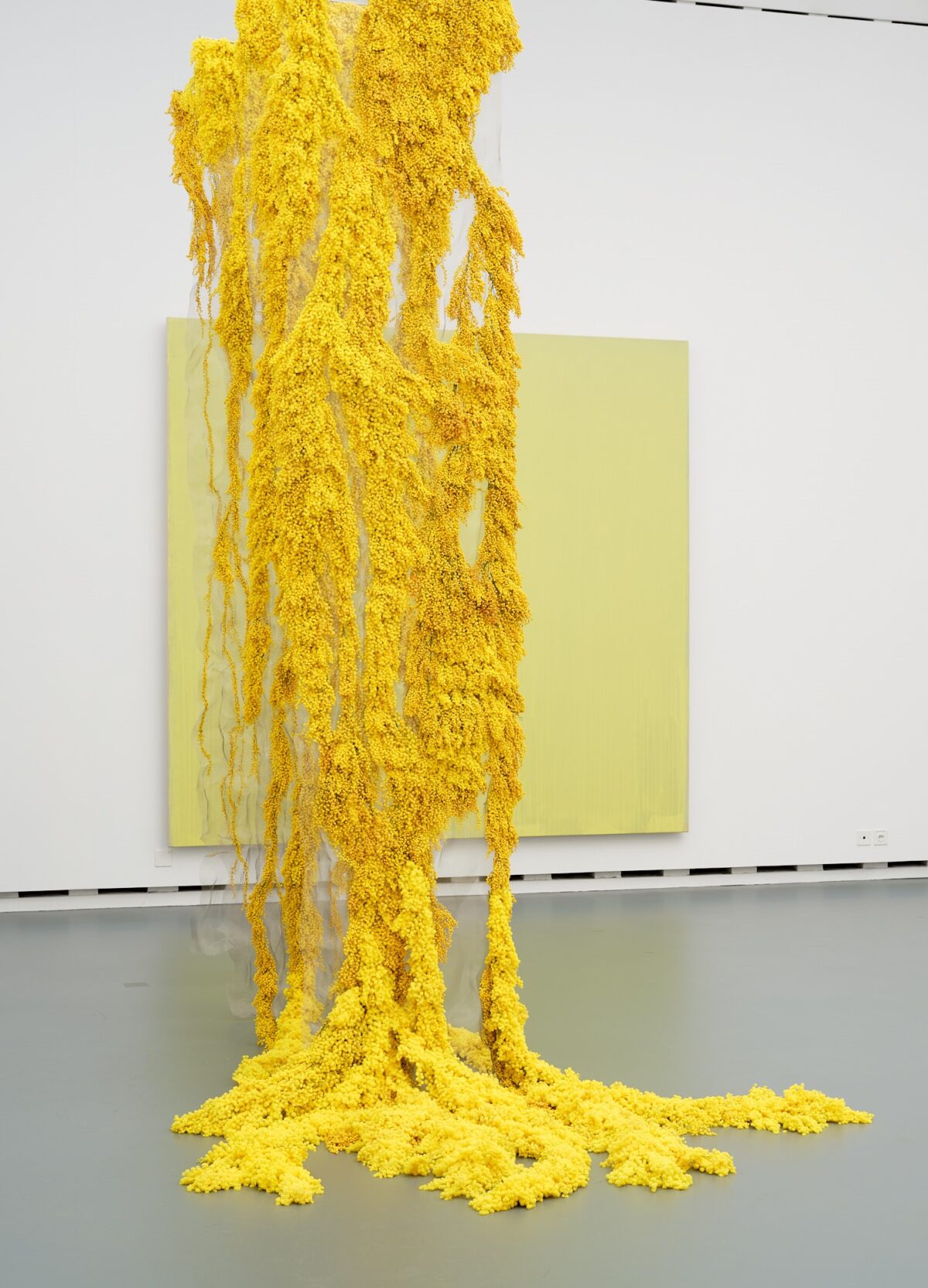
Samantha Bühler’s floral interpretation explores the layering and depth effect of Joseph Marioni’s Yellow Painting. The aim is to reveal the layers of colour in the painting. Freely hanging, translucent metallic meshes take on the function of a canvas and define the space. Mimosa flowers are woven into this structure, dividing the individual layers of colour into four levels. The monochrome setting and varying density of the floral elements refer to the controlled flow of colour and layered application that characterises Marionis’ painting process. In this way, yellow can be experienced not as a surface but as a process – from materiality to the effect of light in space.
Stefan Gritsch + Melanie Schneider
 i
i
3.3.–8.3.2026, Aargauer Kunsthaus
Florale Interpretation: Melanie Schneider, Beringen
Werk: Stefan Gritsch, Ohne Titel, 1993
Aargauer Kunsthaus / Ankauf, 2003
© 2026, ProLitteris, Zürich
Foto: David Aebi, Burgdorf
The material conditions of painting are at the heart of Stefan Gritsch’s work. The artist, who lives in Lenzburg, is interested in colour as a material, as well as in canvas and its sensual properties. He presses masses of paint into blocks and other shapes, so that the paint itself becomes an autonomous work of art. One of the ways he engages with canvas is by painting illusionistic images of it on itself. In Untitled, he uses the three primary colours, which he layers vertically and horizontally in several glazes. The result is a structure that formally imitates the woven material of the picture carrier, thus bringing it back to the surface.
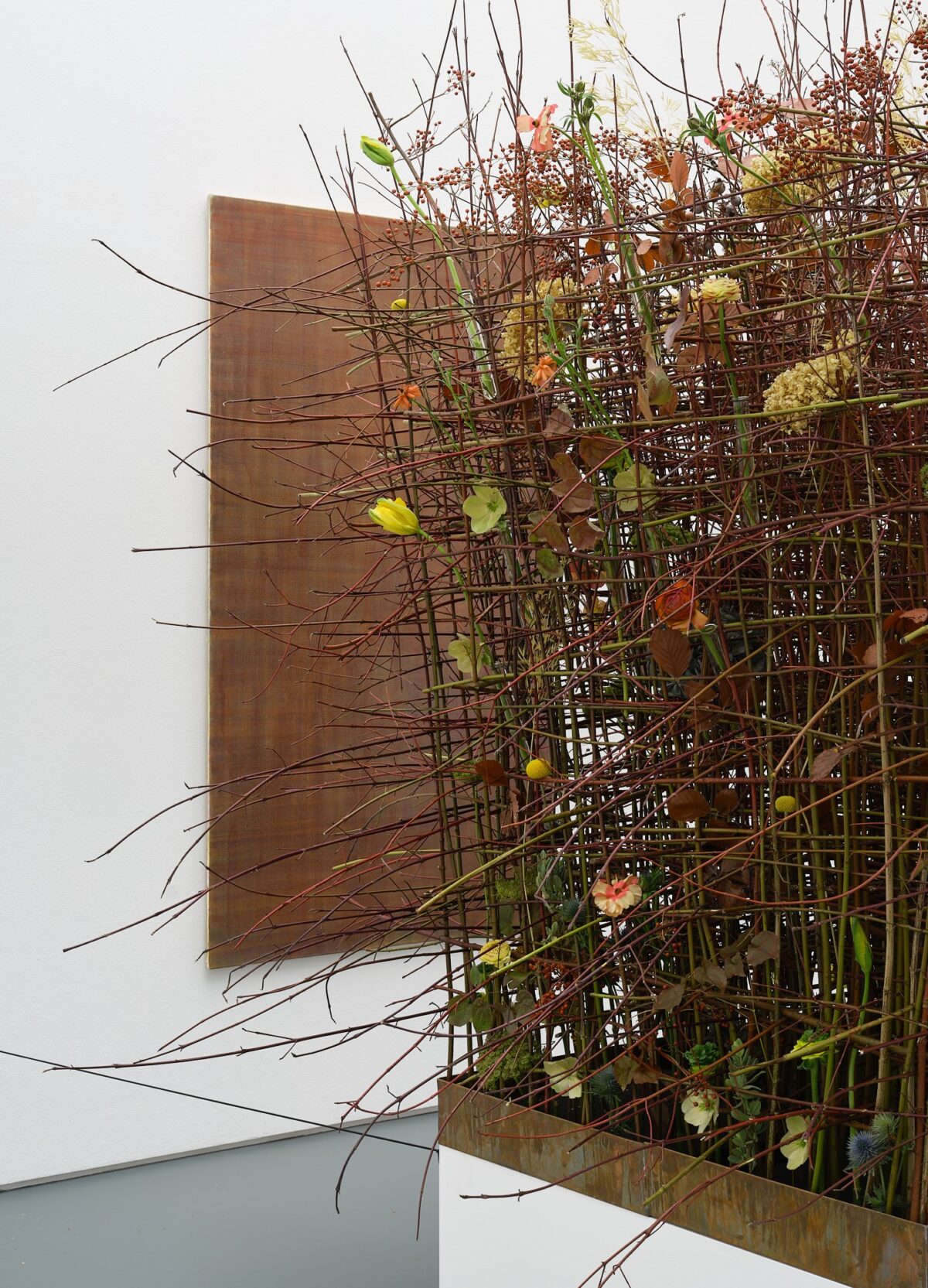
Melanie Schneider takes up Stefan Gritsch’s transformative creative process and translates it into a floral language. Her composition is a precise exploration of colour, structure, technique and light. Red dogwood forms a rectangular system in the shape of a cuboid, reinforcing the painterly depth effect of the image. Within this strict structure, the blossoms and florals assert their independence and value. The deliberately incomplete edge refers to the openness and processual nature of the work. The use of the three primary colours and the reference to the four seasons make the wilting itself an integral part of the creative concept.
Roman Signer + Marcel Gabriel
 i
i
3.3.–8.3.2026, Aargauer Kunsthaus
Florale Interpretation: Marcel Gabriel, Sempach
Werk: Roman Signer, Rinne, 2006 Aargauer Kunsthaus / Schenkung Sammlung R., 2012
Foto: David Aebi, Burgdorf
Roman Signer is known as a performance artist, but describes himself as a sculptor. In his “time sculptures”, he expands three-dimensional sculpture with the dimension of time. Most of the time, they are either the result or starting point of an explosive action in which certain objects undergo changes through the elemental forces of fire, water, air or earth. However, the “event” inherent in the work Rinne takes place in real time before our eyes and makes us ponder what happens when water in a closed channel is set in motion not by gravity but by a fan.
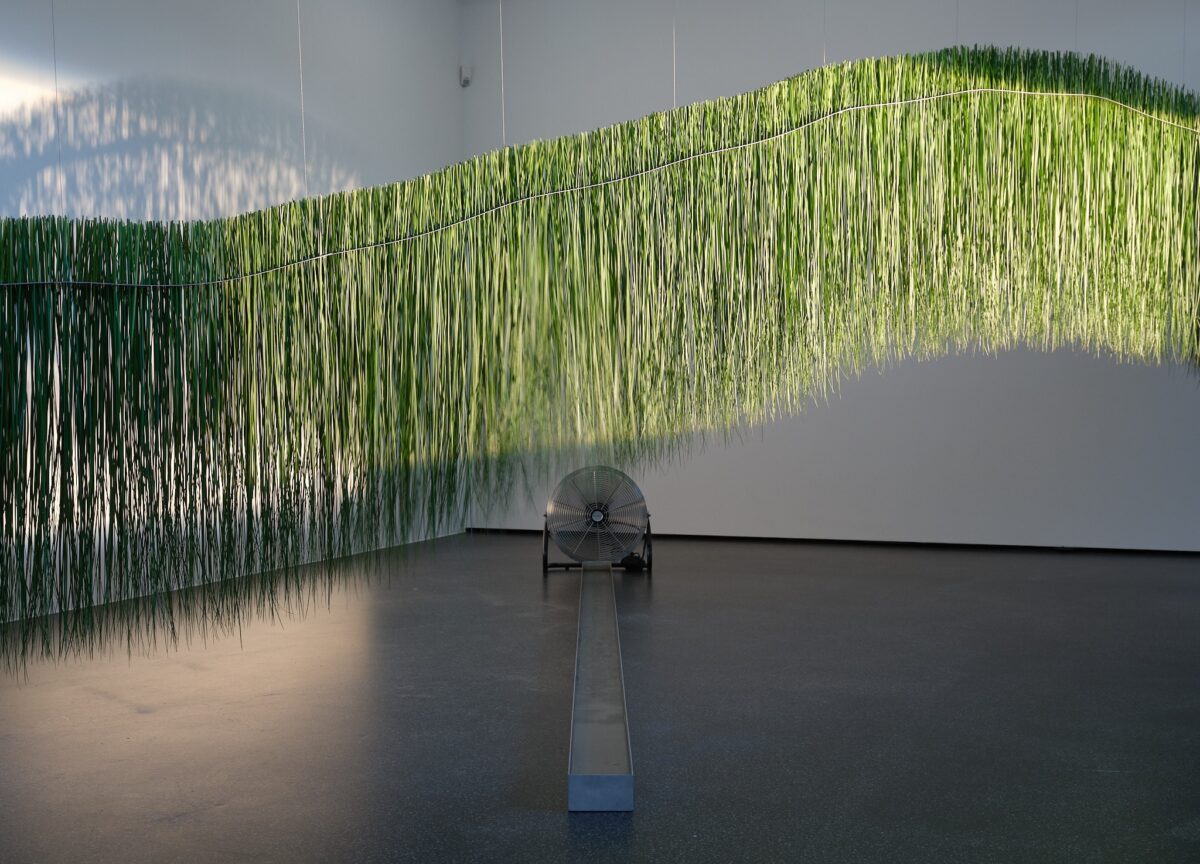
Marcel Gabriel’s floral interpretation responds to Roman Signer’s playful, experimental work. Taking his cue from Signer’s approach to time, movement and simple materials, Gabriel deliberately leaves his ‘floral comfort zone’. Instead of lush flowers, he consistently limits himself to a single plant element: stem grass. This inconspicuous material, often only an accessory in everyday floristry, becomes the central actor here – comparable to the water in the gutter. The airflow generated by the fan sets the grasses in rhythmic motion and they begin to dance. A spotlight projects this dance onto the wall, translating the three-dimensional movement into a fleeting image. In this way, Gabriel reverses the usual approach to floral design and turns Signer’s sculpture itself into an image – light, precise and with playful consistency.
Barbara Müller + Annika Egger
 i
i
3.3.–8.3.2026, Aargauer Kunsthaus
Florale Interpretation: Annika Egger, Muri bei Bern
Werk: Barbara Müller, Ohne Titel, 2015
Aargauer Kunsthaus / Ankauf, 2015
Foto: David Aebi, Burgdorf
While earlier works by Aargau-based artist Barbara Müller show a tendency towards vertical or horizontal layers of colour placed side by side and on top of each other, the boundaries between surfaces become increasingly blurred in later works such as Untitled. The result is abstract forms and colour compositions, some of which vaguely resemble landscapes. The colour gradient now shifts in all directions and the working process becomes noticeable: the painter pours heavily diluted oil paint onto the canvas, which is often lying on the floor, and spreads it with tools or lets it flow across the picture by tilting the canvas in different directions.
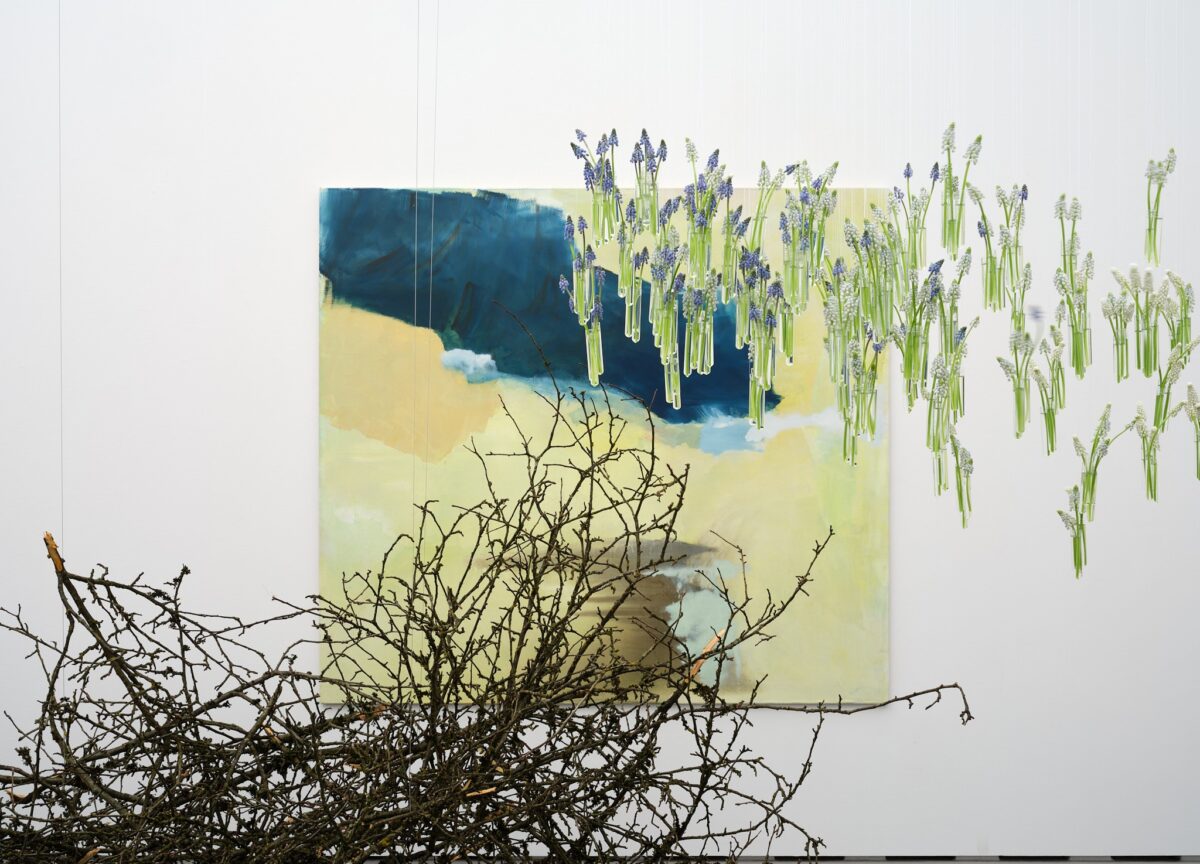
At first glance, the blue colour scheme of Barbara Müller’s work appears heavy and dense to Annika Egger – like a gathering storm cloud. However, upon closer inspection, a quiet inner strength is revealed, heralding movement and change. This perspective forms the basis of her floral interpretation. The design is deliberately transparent and airy, drawing the eye into the interior of the work, where space for associations is created. Here, blue represents winter, which still clings to spring, but at the same time it is also a sign of hope and new beginnings. Blue grape hyacinths refer to the time before the storm: they form a cloud-like structure that carries tension and expectation – in the knowledge that after every storm, nature awakens to new life.
Christian Megert + Heidi Bisang und Andrea Lehmann
 i
i
3.3.–8.3.2026, Aargauer Kunsthaus
Florale Interpretation: Heidi Bisang + Andrea Lehmann, Solothurn
Werk: Christian Megert. Light Kinetic – Four turning squares, 1973
Aargauer Kunsthaus / Ankauf, 2023
© 2026, ProLitteris, Zürich
Foto: David Aebi, Burgdorf
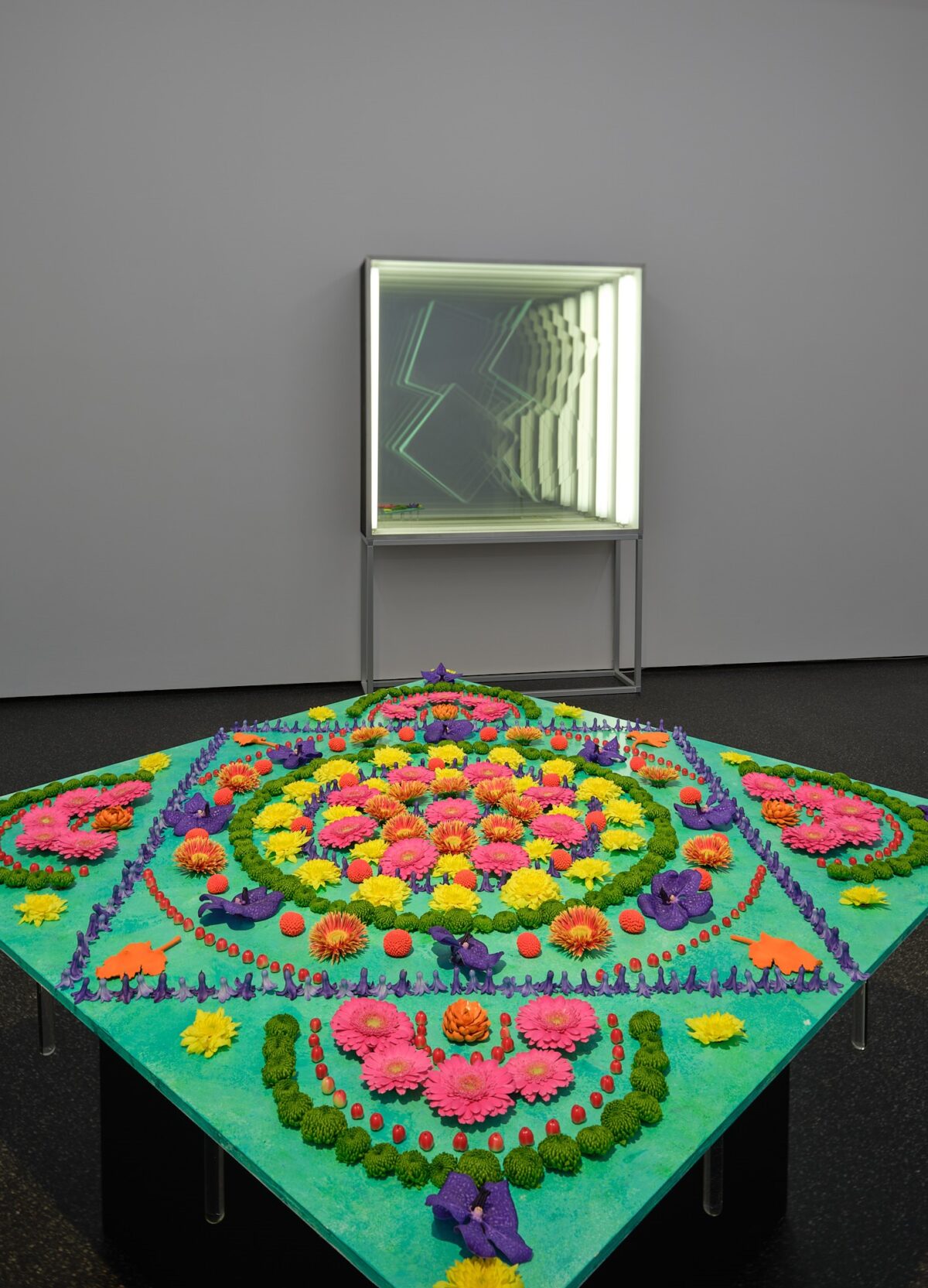
As a member of the ZERO artist group, which uses non-artistic materials and replaces colour with light and movement, Christian Megert has been creating monochrome material and structural images since the 1960s. In his work as a painter, he also seeks depth and three-dimensionality in his images, which has led him to use glass and mirrors. In his technically complex ‘light boxes’ or ‘infinite space boxes,’ made of wood, mirror glass, and fluorescent tubes, he increases the depth of space to infinity. In Light Kinetic – Four Turning Squares, he also incorporates movement by means of rotating mirror glass elements. The work confronts viewers with unfamiliar spatial dimensions and challenges their perception.
Heidi Bisang and Andrea Lehmann take up the visual dynamics of Christian Megert’s work and deliberately counter it with a decelerated, meditative gesture. In the form of a flower mandala, they translate the kaleidoscopic image effect into a quiet, contemplative spatial experience. Chrysanthemums, echeverias, kalanchoe leaves, hypericum, wallflowers, germini and craspedia structure the composition and emphasise rhythm, repetition and concentration. As a counterpoint to today’s sensory overload from screen images, the floral work invites contemplation and conscious perception.
Silvia Bächli, Eric Hattan + Marie Bongard
 i
i
3.3.–8.3.2026, Aargauer Kunsthaus
Florale Interpretation: Marie Bongard, Männedorf
Werk: Silvia Bächli + Eric Hattan, Quer, 2017
Aargauer Kunsthaus / Ankauf, 2017
Foto: David Aebi, Burgdorf
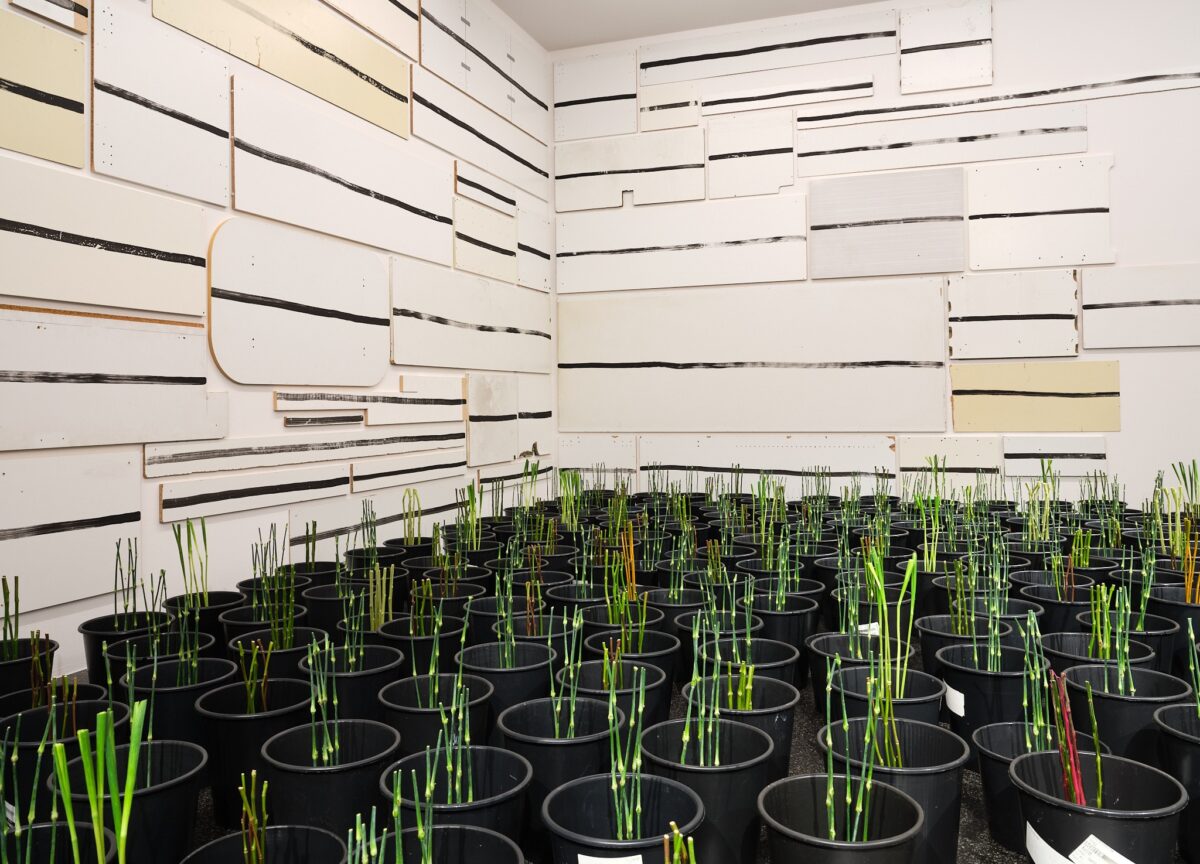
While Eric Hattan captures everyday scenes or easily overlooked objects on film and builds sculptures from simple materials, Silvia Bächli is known as a draughtswoman. She works mainly with black paint and paper, exploring how graphic expression relates to the surrounding space. Quer brings together the couple’s artistic approaches. Sixty-four pieces of furniture found on the streets of Paris are used to create a site-specific arrangement on the wall that runs around the corner. A thick black line of acrylic paint divides all the whitish ‘panels’ hung next to and above each other horizontally into two parts, connecting them to form a single large drawing that integrates the urban space into the museum space.
Marie Bongard’s floral interpretation responds to the combination of drawing, object and space. Just as Silvia Bächli and Eric Hattan reassemble everyday materials and place them in a new context, Marie Bongard works with leftovers from cut flower production. 220 black disposable buckets are filled with parallel stems from unsold bouquets, forming a serial, seemingly random composition. The removal of all flowers shifts the focus from decorative beauty to structure, line and materiality, raising questions about value and waste. The reduced stems make direct reference to Bächli’s drawn lines, while visibly inserted foam cubes take up the open construction of Quer. The field of buckets extends to the artwork, creating a common horizon that brings the various elements together.
Gianfredo Camesi + Marianne De Tomasi
 i
i
3.3.–8.3.2026, Aargauer Kunsthaus
Florale Interpretation: Marianne De Tomasi, St. Gallen
Werk: Gianfredo Camesi, Organisme spatiale, 1965
Aargauer Kunsthaus / Schenkung Sammlung R., 2012
Foto: David Aebi, Burgdorf
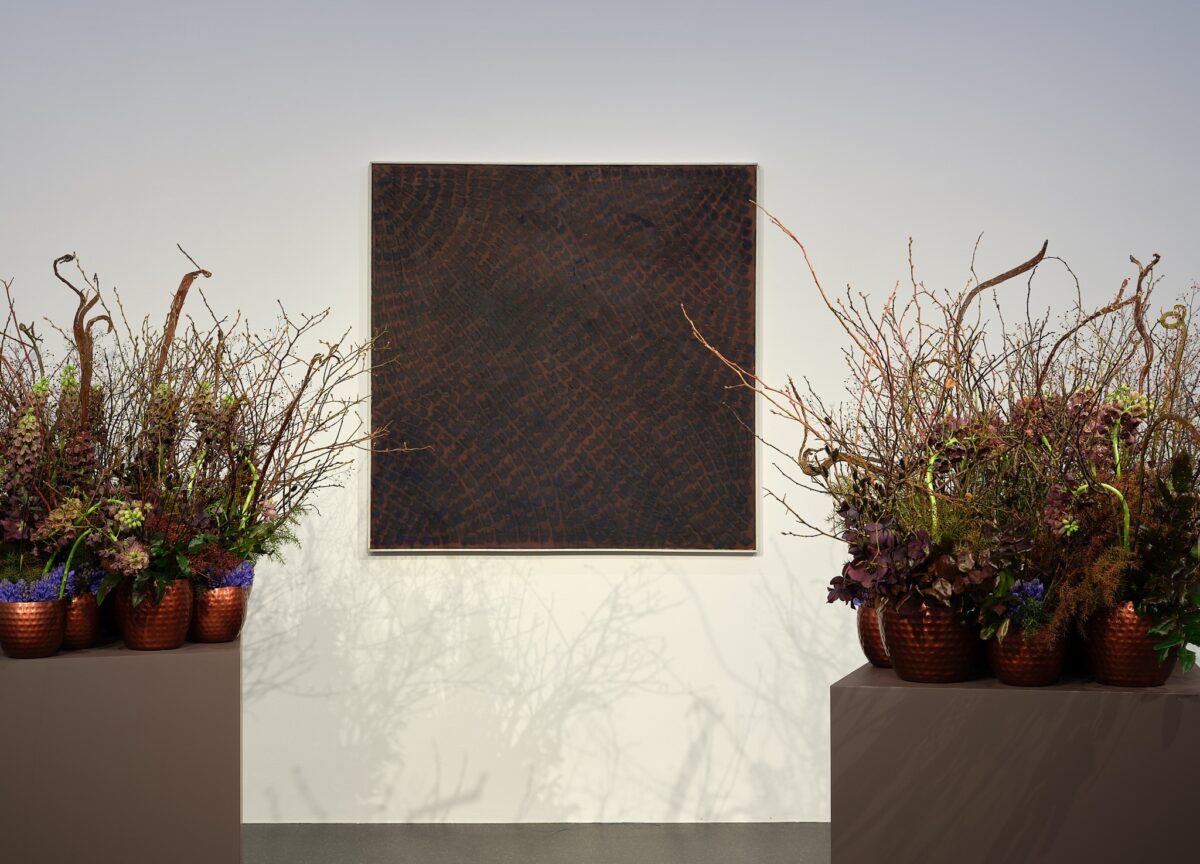
The Ticino painter and sculptor Gianfredo Camesi trained as a structural draughtsman before turning to art. He taught himself to paint by copying the great masters and portraying family members. He later became one of the first representatives of Swiss conceptual art. Camesi regarded nature and the universe as something that is constantly changing. In his works, he visualised his observations in the form of repetitive symbols and signs. In the work with the ambiguous title Organisme spatiale, countless symbols arranged in curved lines can also be seen. The constantly changing directions of the curves create the impression of movement. The arrangement is reminiscent of the smallest particles of matter that structure space and organisms.
Marianne De Tomasi’s floral interpretation responds to the dark colours and organic, rhythmic structure of Gianfredi Camesi’s work. Based on the concept of the “spatial organism”, she has developed an arrangement that appears walk-in, allowing visitors to experience movement, density and change. Seasonal flowers such as Japanese cedar, ribbon willow, ginseng, oriental hellebore, Japanese lavender heath, chessboard flower and Persian imperial crown reflect the form, texture and dynamics of the work. Dark natural plants create an exciting, almost cosmic atmosphere, while the fragrant flowers of the blue hyacinth claim the airspace for themselves. Metallic, copper-coloured vessels reflect the warm undertones of the image, while green stems create deliberate contrasts and enliven the almost monochrome structure.
Per Kirkeby + Annika Junghans
 i
i
3.3.–8.3.2026, Aargauer Kunsthaus
Florale Interpretation: Annika Junghans, Basel
Werk: Per Kirkeby, Ohne Titel, 1980
Aargauer Kunsthaus / Schenkung Dr. Heinrich E. Schmid zu Ehren von Beat Wismer, 2009
Foto: David Aebi, Burgdorf Foto: David Aebi
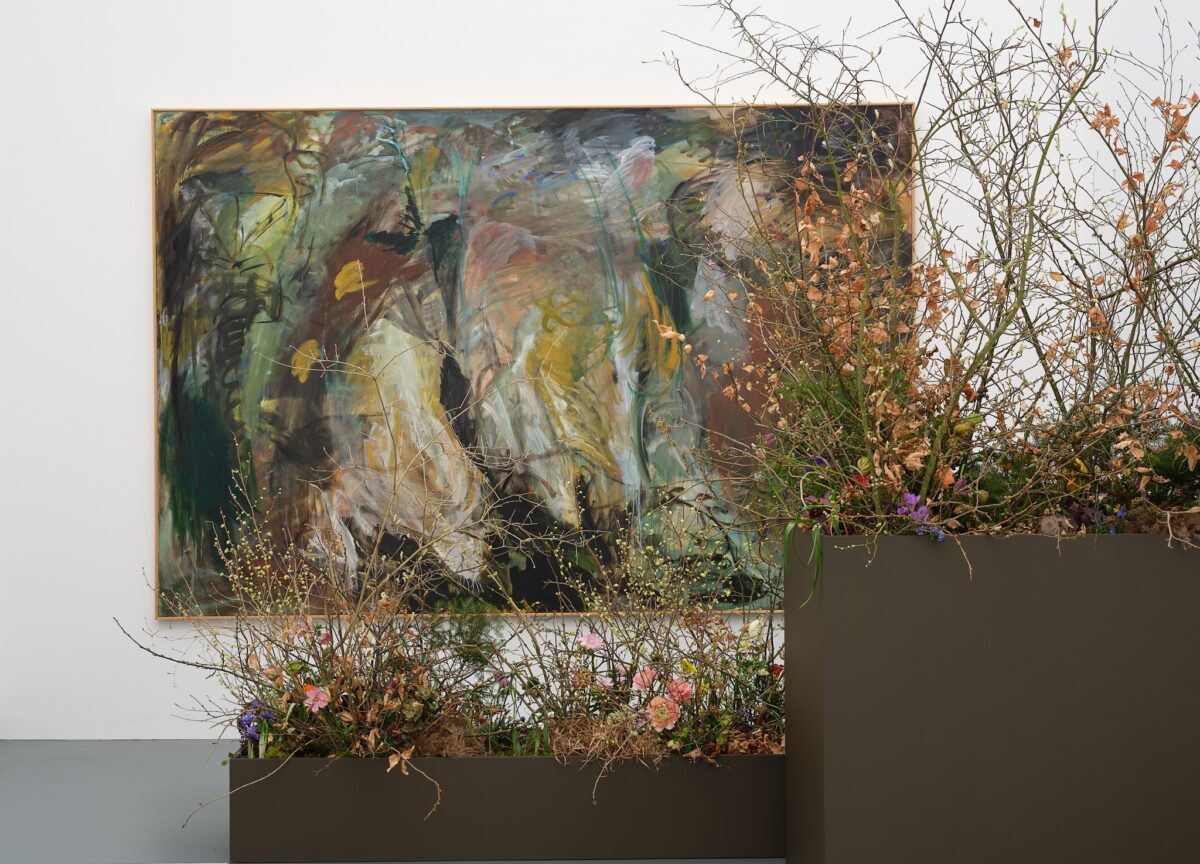
Per Kirkeby’s painting was created at the time of his international breakthrough. With a doctorate in geology, the artist is interested in landscape impressions, which henceforth become his main motif. His paintings, such as Untitled, characterised by thick, powerful brushstrokes and earth tones, elude pure abstraction through the suggestion of trees and rocks, yet Kirkeby is not concerned with depicting an actual existing landscape. Rather, the act of painting and the painting itself become the landscape. ‘I paint a picture, and the process of creating a picture is in many ways reminiscent of the processes that have created the earth or landscapes over a very long period of time,’ says the artist.
Annika Junghans’ floral interpretation is based on an understanding of painting as a process and sees the work not as a representation of landscape, but as a visible development over a long period of time. The focus is not on the motif, but on the process of becoming. Junghans works directly, intuitively and without a vessel. Natural structures, earthiness and apparent chaos characterise the composition. Flowering branches of rock pear, early spring roses and checkerboard flowers combine the different growth forms of perennials, bulbous plants and wood. The pedestals become a stage for layering, tension and compression. The floral work invites us to read time, change and materiality.
Barbara Müller + Claudia Alijew Wüthrich
 i
i
3.3.–8.3.2026, Aargauer Kunsthaus
Florale Interpretation: Claudia Alijew Wüthrich
Werk: Barbara Müller, Ohne Titel, 1998/99
Nachlass Barbara Müller
Foto: David Aebi, Burgdorf
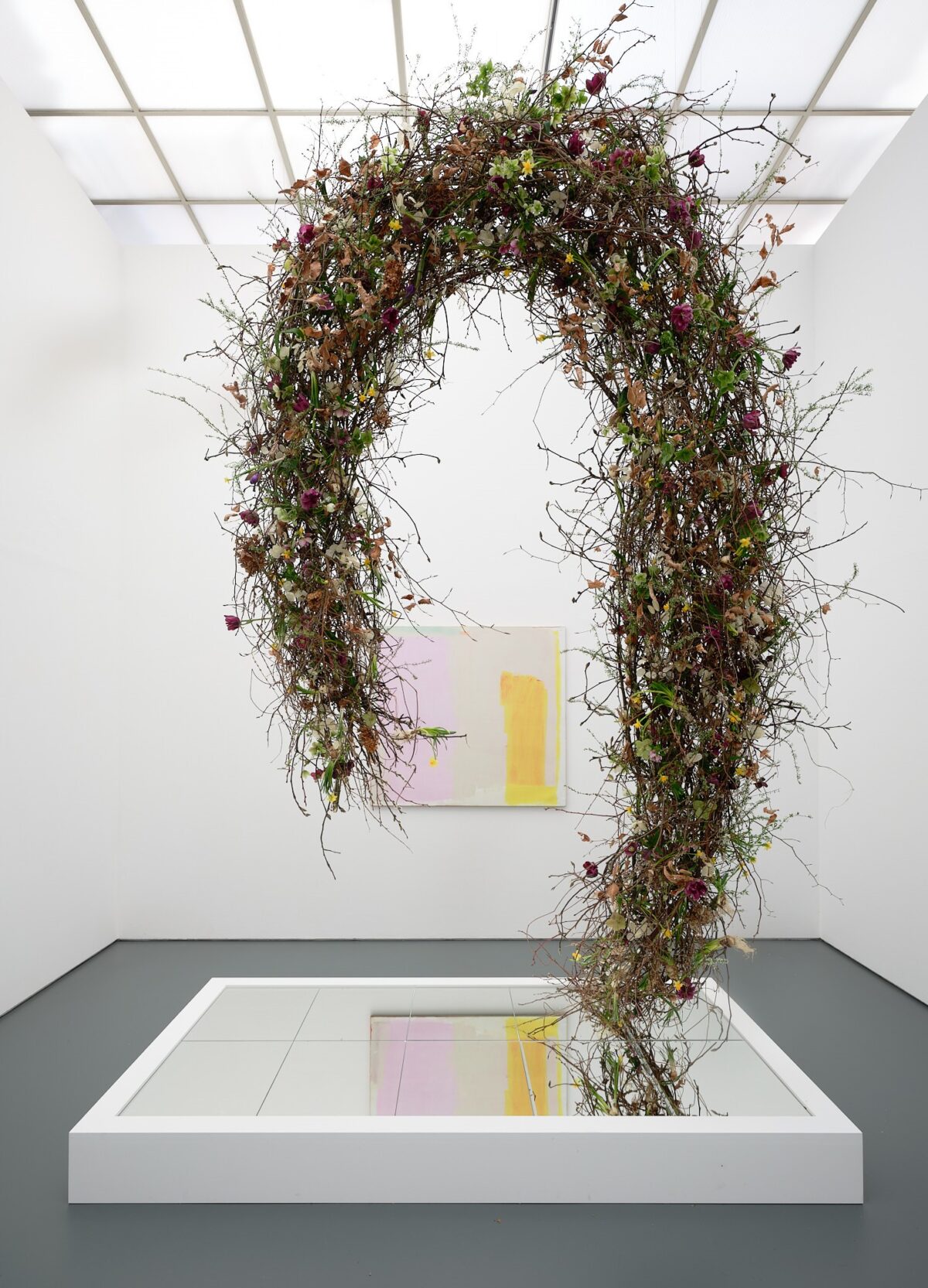
Barbara Müller worked as a goldsmith before beginning her artistic career in the late 1980s. She initially created objects and small installations, working with different colour materials and unusual image carriers. During the 1990s, she moved away from three-dimensional work and increasingly focused on oil painting. Despite the thin application of paint, the artist also creates depth in this two-dimensional medium by layering several layers of glaze on top of and next to each other and placing them in an exciting relationship to the canvas through visible empty spaces. The works have no titles and invite open viewing and interpretation.
Claudia Alijew Wüthrich responds to Barbara Müller’s painting with a restrained, finely tuned floral arrangement. Like the artist, she works with layering, transparency and the interplay between presence and emptiness. The openness of the painting is mirrored in a floral composition of fresh beech branches, lady fern and selected spring flowers. Crocuses, daffodils and spring roses – some with visibly washed-out bulbs – refer to becoming and passing away. The work is carried by personal memories and quiet affection and enters into a calm dialogue with the painting – not illustratively, but as a gentle embrace that opens up new poetic spaces of resonance.
Pia Fries + Evelyn Krebs
 i
i
3.3.–8.3.2026, Aargauer Kunsthaus
Florale Interpretation: Evelyn Krebs, Zürich
Werk: Pia Fries, schwarze blumen, erucarum ortus, 2005
Aargauer Kunsthaus / Ankauf mit einem grosszügigen Beitrag von Ellen und Michael Ringier, 2023
© 2026, ProLitteris, Zürich
Foto: David Aebi, Burgdorf
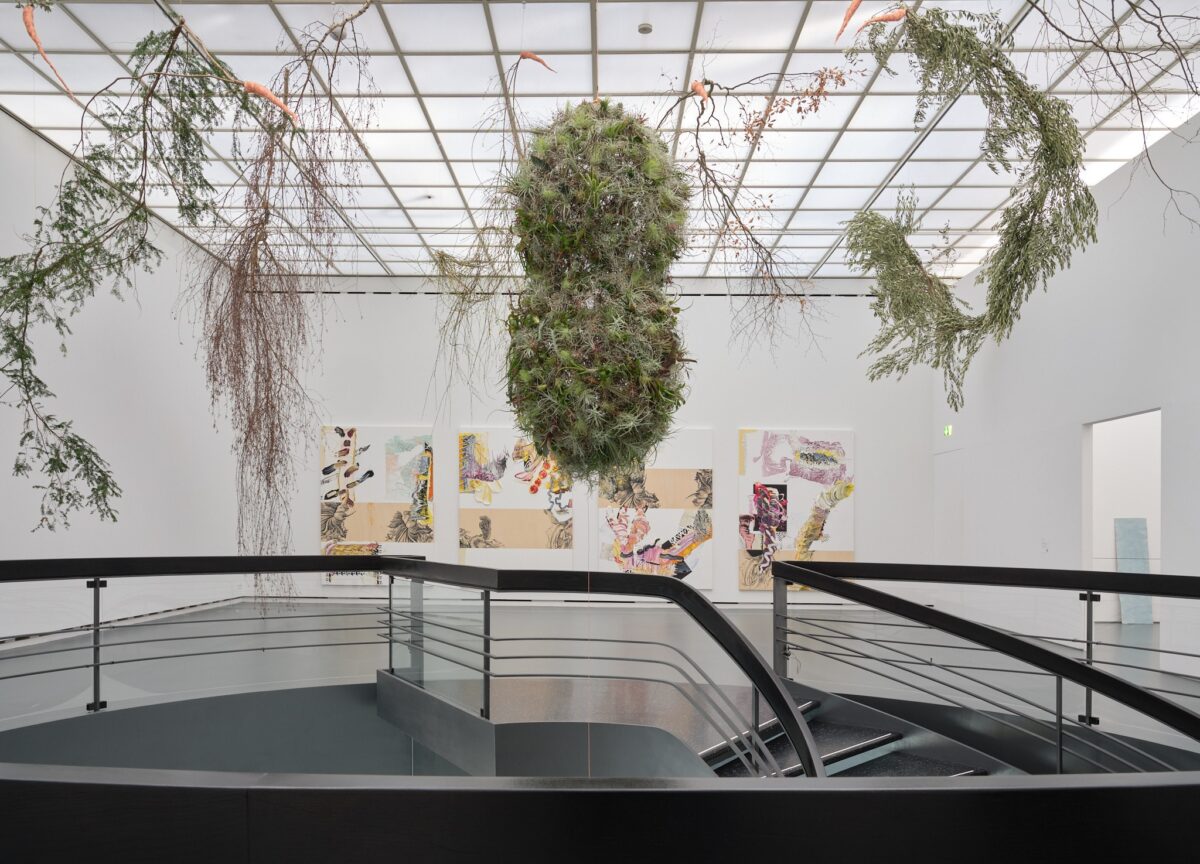
Award-winning, internationally active artist Pia Fries combines various media in her paintings. Her oeuvre revolves around the themes of transformation and creative and perceptual processes. In the work schwarze blumen, erucarum ortus (black flowers, erucarum ortus), the artist effectively blends black screen prints of plant illustrations by naturalist Maria Sibylla Merian (1647–1717) with colourful painted flowers. She transforms the scientific still images into abstract painterly metamorphoses. The impasto application of oil paint and the visible traces of different tools focus attention on the layers, textures and dynamics of the paint and on the material aspects of painting.
Evelyn Krebs responds to Pia Fries’ work with a floral piece that focuses on metamorphosis and the power of nature. As in Fries’ paintings, transformation is experienced as a process: layers emerge, dissolve and reconnect. The floral design works with natural materials and botanical elements reminiscent of protective shells, transitions, magical places and phases of growth. A cocoon becomes a symbol of transformation. Smoky quartz refers to grounding, energy flow and interconnection, while long, root-like threads run through the space. Plants from Maria Sibylla Merian’s botanical studies bridge the gap between natural history and contemporary aesthetics. The floral work invites a sensual experience of change.