Shamiran Istifan
Manor Art Prize 2026
The Afghan-German artist and author Moshtari Hilal takes us on a journey through the works of Shamiran Istifan and places them in their historical context.
In a Sense, a Cyborg Has No Origin Story
 i
i
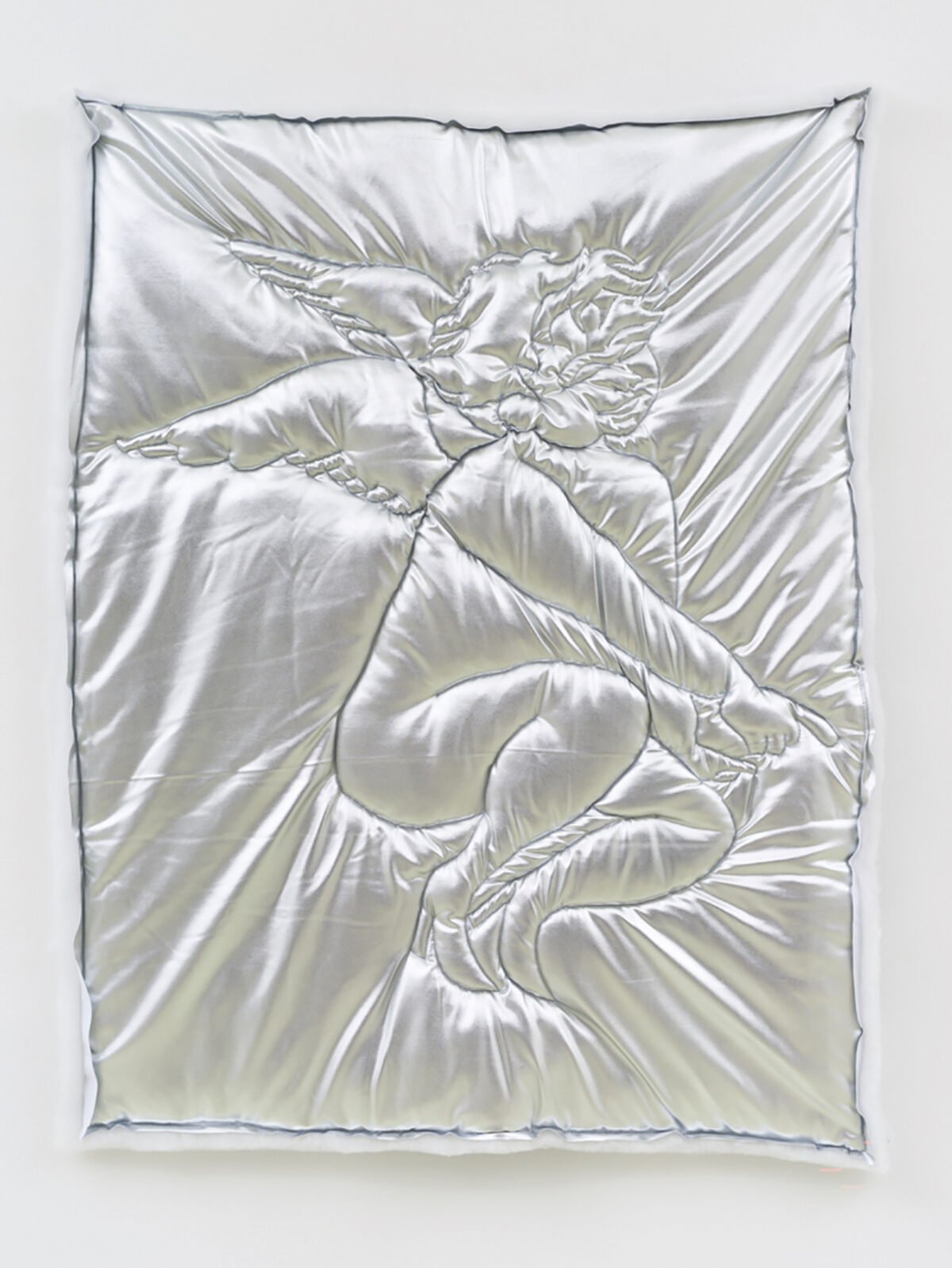
Metallic-Jersey, Watte, Garn, Leinen, 109 x 88 cm
Mit Genehmigung der Künstlerin
© Shamiran Istifan
There is a figure that moves through Shamiran Istifan’s work like an echo without a single source. It is reckless, dressed to kill and fundamentally suspicious of everything and everyone. It appears and disappears: as a chrome-coloured surface, as a calculating angelic character, as a postoperative plaster on a nose, as the dead waiting for their funeral. This figure is neither mythical nor theoretical, rather it is found in the tension of a depilated calf, the faded mark left behind by lipstick or the reproduction of a gaudy advertising hoarding.
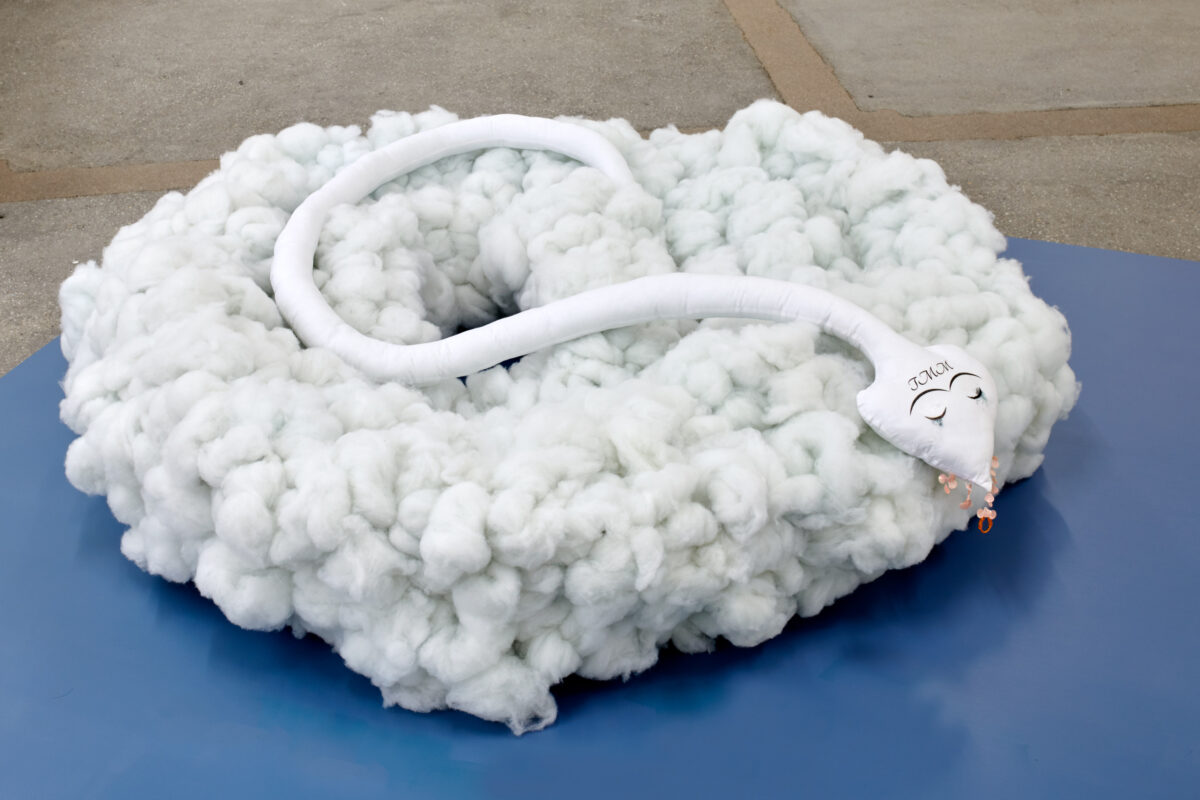
When the mystical mythical Şahmaran – half woman, half serpent – meets Donna Haraway’s A Cyborg Manifesto (1985) this figure becomes somewhat more tangible. The biologist and philosopher of science put forward the cyborg as a symbol for the subject of the late twentieth century: a being that exists at the borderline between human and machine, nature and culture, the self and the other, without having the possibility of ever returning to an original whole. The cyborg was a feminist intervention that challenged the idea that identity can be based upon pre-technological and precolonial authenticity. Şahmaran, the queen of the serpents and a character enshrined in the folklore of Western and Central Asia as a pre-Abrahamic deity, embodies a similar hybrid creature. She is wise and gracious, her flesh brings wisdom to some and spells disaster for others: in the Abrahamic interpretation she is regarded in each of her forms – as both woman and serpent – as a temptation, a source of danger and, hence, a sin. She encapsulates the fate of the misinterpreted, misunderstood and, ultimately, persecuted being.
In her Cyborg Manifesto, Haraway argued that categorical instability was not a tragedy but the cyborg’s intention. Istifan’s work expands upon this idea. In contrast to the cyborg’s lack of an origin story, genealogy remains a constant aspect of her practice. The figure that she is pursuing bears traces of tangible characteristics: it occasionally has a body, strikes a pose, reflects in the mirror and cuts off its nose. The Assyrian-Aramaic diaspora provides a fundamental yet indirect resonance space for Istifan’s work. In the final decades of the Ottoman Empire, and in particular between 1914 and 1918, the ancestors of this diaspora were subject to systematic mass killings: the genocide that is known in Syrian as seyfo, which also means ‘sword’. Due to the fragmentary nature of the archives, historical estimates vary but it is assumed that up to eighty percent of the Assyrian population was eliminated during the genocide. This history of violence continues to the present day. IS attacks on Assyrian and Yezidi communities in Iraq and Syria in 2014 represented a further highpoint in this persistent persecution.
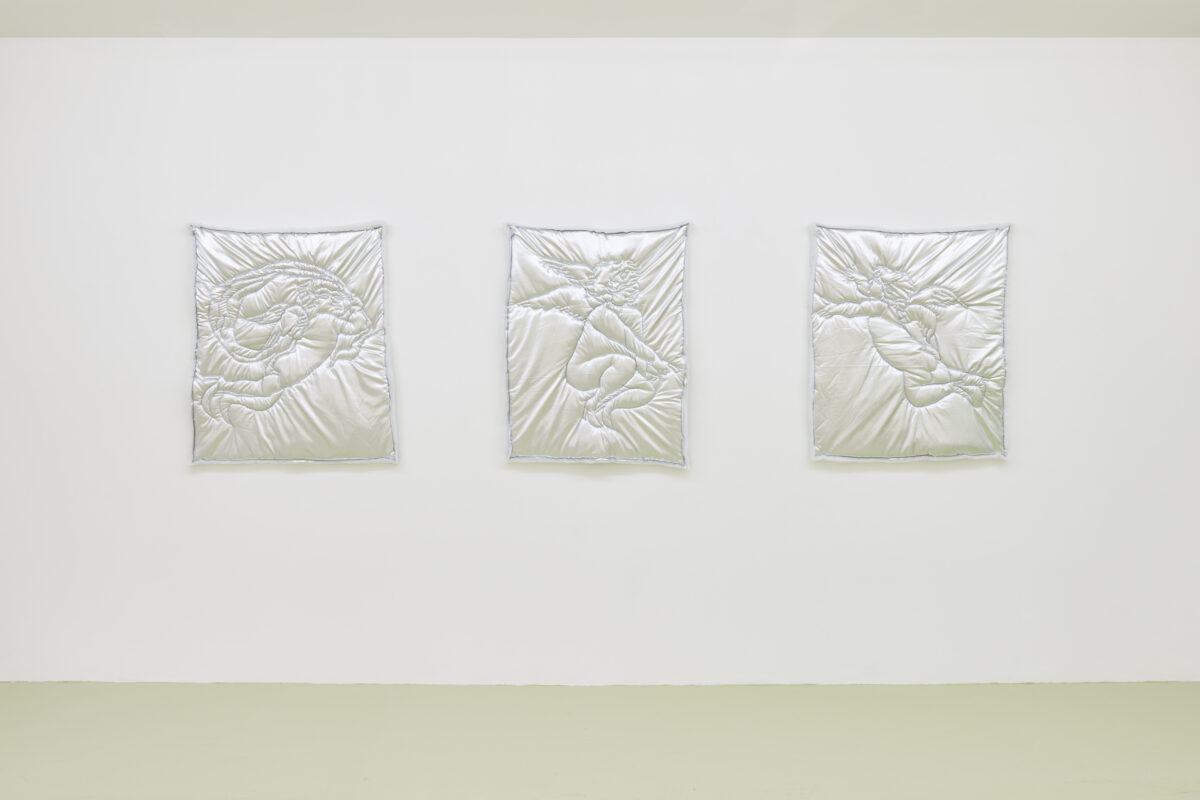
Shamiran Istifan’s work is permeated by this history, without ever degenerating into mere illustration. Her series Maryam I–III (2022) – quilted wall hangings made from silvery material that depict cherubic, angelic figures – is dedicated to members of her family, whose stories, as she says, remain untold to this day. In Christian iconography, the angel is a messenger, a witness, a further hybrid creature between the human and the so-called supernatural. In Istifan’s depiction, the angel also becomes an archivist of the disappeared.
 i
i
Metallic-Jersey, Baumwolle, Futter, Garn
Foto: Theo Christelis
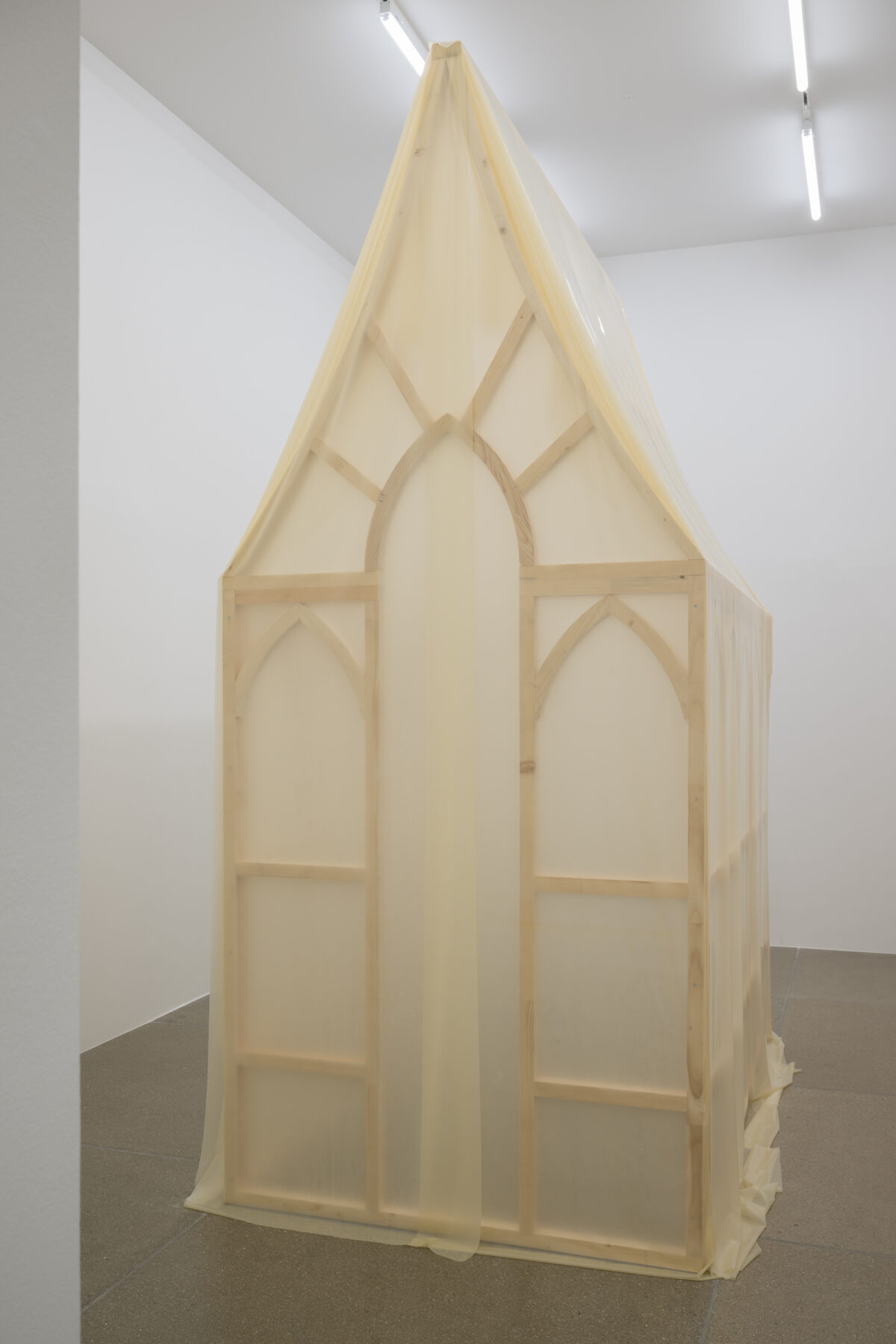
Installations that recall abandoned malls, wedding rooms or sacred buildings generate a curious sense of emptiness that is, at the same time, charged with individual and intimate allusions to the reference space of the artist. The volumetric works are charged like monuments and memorials; they are haunted by an inherent restlessness that Istifan approaches with every work. Each piece portrays its own cultural signifier, a symbol, whose meaning is determined by social rules, stories of violence and patriarchal power relationships. Some of the works feel like portals into other dimensions – liminal thresholds, so-called upside-downs, across which Istifan’s inner life and stories come to the surface, cloaked in the aesthetic of a monumental culture of consumption. The everyday becomes the supernatural: the abandoned gothic streets recall a ghost town, the living rooms of migrants in industrial districts are teleported into the elegant heart of the city. Shamiran Istifan permits herself to borrow from the genres of horror or science fiction, without using them in full. Despite addressing such sombre subjects, her works remain far from material dilapidation. Rather, this futuristic opulence conceals her unanswered questions of power: who owns this world and which bodies are being longed for??
 i
i
Manor Kunstpreis 2026
12.6.–6.9.2026, Aargauer Kunsthaus
Shamiran Istifan, Skin City, 2026
Foto: ullmann.photography
When the haunting figure takes on concrete form, it appears as a hyperfeminine figure: a body fully aware of its own staging. Istifan’s hyperfemininity is not a naive appropriation of a voyeuristic aesthetic. Rather, it is a conscious exaggeration of the expectations on the body – an exaggeration that goes so far beyond the objective of mere adaptation that it even lays bare visual regimes and value systems. It provokes us with its calculated shifting of beauty standards: from social expectations about the body to the physical manipulation of the social. And yet, the character that emerges from this process remains an embodiment of real attributions. Istifan’s use of classically ridiculed kitsch also extends beyond the body itself: metallic materials, embroidered angels, logos, decorative excesses. The European art world regards this aesthetic as representative of the bad taste of the working class: the furnishings in the migrant’s living room, the parties organised by women who still haven’t learned that less is more because no one has taught them that it is performative restraint that characterises the social class that they hint at with their displays of opulence. From this perspective, taste is not an enlightened category that provides us with a universal benchmark, but a social mechanism that corrects how we see one another.
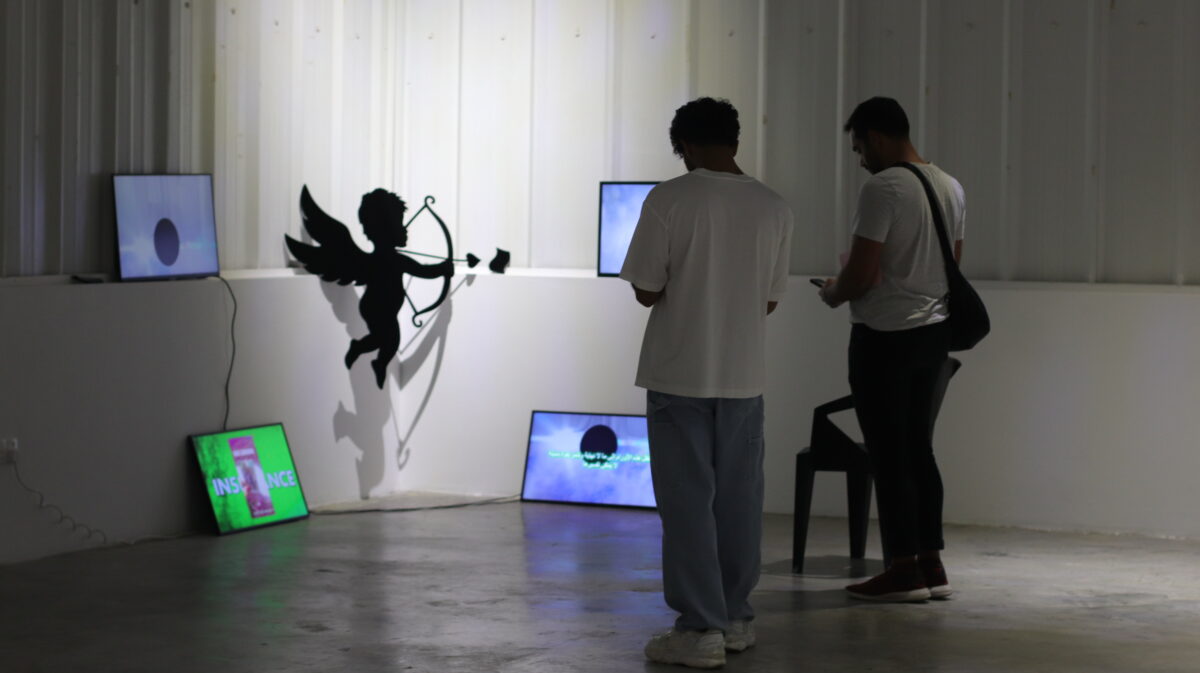
One of these concrete figures is the gold digger: one of the most misogynist and classist archetypes of the modern era. By instrumentalising her attractiveness in order to safeguard her material existence in an unjust world, the gold digger subverts the narrative of romantic love. This notion of the romantic avoids addressing the political and economic inequality of middle-class marriage, whereas the existence of the gold digger lays bare interdependencies and asymmetries. In Istifan’s work Gold Digger (2023), she depicts this figure as a stereotypical cupid with a love arrow – in an ironic reference to the power of illusory views of love in a capitalist world. In a certain sense, the gold digger can thus be seen as a direct descendant of the witch, as she is portrayed, for example, by the philosopher Silvia Federici: as a woman, whose economic independence and autonomous control of her own body is regarded as a threat that leads to her social ostracism and persecution. In Caliban and the Witch (2004), Federici analyses the systematic persecution of witches in the early modern era and the way in which this persecution targeted all women who exercised some control over care work, property and the common knowledge shared by society. The witch was threatening not because of her magic but because of her autonomy: over her body and over assets and knowledge that thus escaped the control of the capitalist system. The gold digger has inherited this threatening role. She understands the functional relationships in the patriarchal system and uses these to her own advantage with the same level of calculation with which she also deals with its material realities. Far from being morally questionable, this calculating approach merely reflects the conditions under which she is forced to experience her own body. The male expectation that this economic arrangement should not encroach upon private life is itself no more than a fiction, and it is precisely this fiction that haunts men.
 i
i
Video installation
Installationsansicht Getting Over the Color Green
14.–22.3.2023, Warehouse 46 / Alserkal Avenue, Dubai
By presenting Gold Digger for the first time in a gallery in Dubai, Shamiran Istifan established a link between the reception of her work and the location in which it was exhibited. For where else but Dubai is the stereotype of the ‘gold digger’ so intensely condensed and simultaneously drawn in – as a hub of violent resource extraction from Sudan and global gold circulation? Social media also shares the promise of material gain – as exemplified by the marketing of arm candy to young women – with a vehemence that recalls new forms of human trafficking. Here, the gold digger is no longer a feared traitor; rather she is integrated into the prevalent economic arrangement, which expects nothing of her body other than being a decorative and entertaining extension of male capital. Because the rich man remains in possession of gold – and here oil as well – while the beautiful woman turns into the endangered subject. None of these promises carry any real security, and the calculative logic of the attractive woman is turned back against her. In this context, the irony of the figure of the manipulative angel taking aim at a banknote with her heart-shaped bow and arrow becomes even more sombre and cynical.
Shamiran Istifan takes this complexity to the next level in her work through both her use of symbols and her references to luxury. Logos of companies such as Louis Vuitton appear not as naive indicators of status but as twin gestures: appropriation and criticism as one. Here, we can see a further figure beginning to emerge: a foreigner, a chaya, who is demanding recognition in a system that questions whether they even belong. This recurring exploration of the notion of belonging in Istifan’s work takes place at not just the symbolic but also the physical level. The video work Trip to Jerusalem (2022) addresses her own nose job, retelling the story of the invasive, surgical adaptation to a notional white norm. The nose was one of the central markers that nineteenth-century proponents of modern race theory used to classify humans. Accordingly, it has been seen as a means of racial assimilation ever since the introduction and technological development of rhinoplasty. As a result, the operation on the nose, and the associated alteration in its form, invariably combines the promise of social advancement with a discussion of the issue of structural coercion.
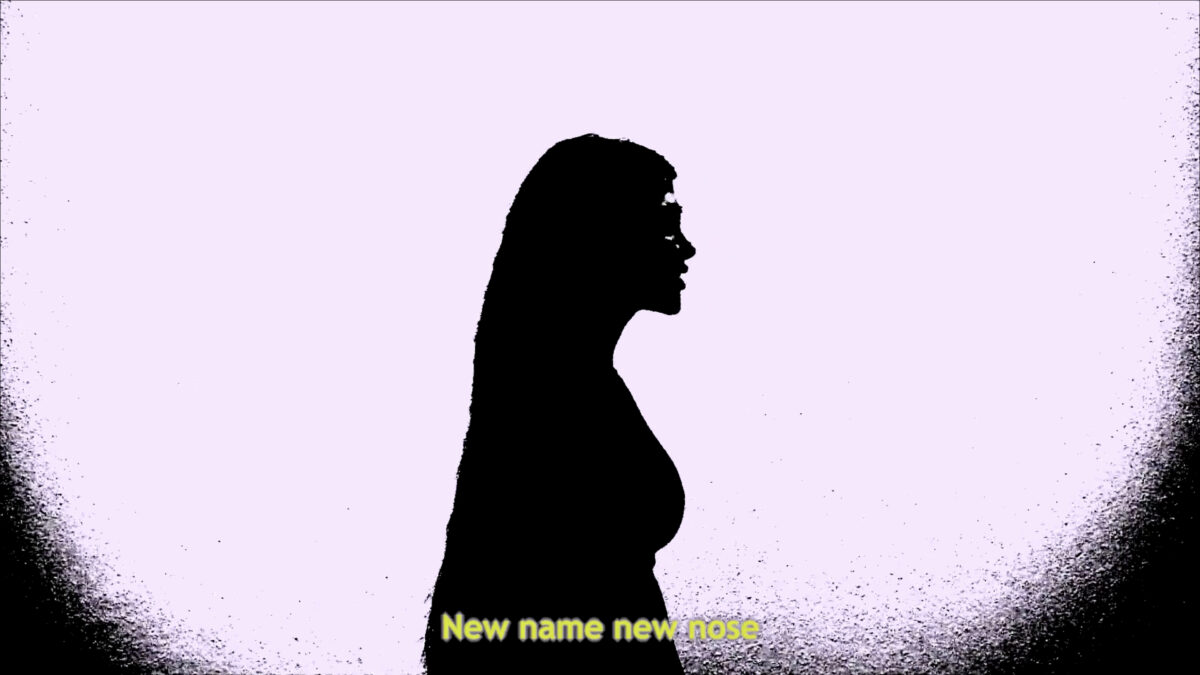
Haraway describes the cyborg as a body that is shaped by technological interventions with the aim of advancing within social structures and, hence, exposing their inherent violence. Istifan’s exploration of the nose job is nothing other than the personification of this cyborg condition. The surgical reshaping of the nose is a concrete material manifestation of an ongoing social process, in which the body is labelled, classified and hierarchised. This biotechnological intervention in the natural body is carried out in the service of social legibility – but in Istifan’s work, and in her own embodiment of the issue, there is no resolution of the conflict between the body and society. The nose job fails to lead to successful assimilation.
In the video work, six dark-haired women stage a game of Musical Chairs, which was originally known as ‘Trip to Jerusalem’. Each is dressed in black and wearing a performative postoperative plaster on the nose and they remind us of a funeral: it is Shamiran Istifan’s old nose that they are carrying to its grave. Survival and loss collide, while the women compete for the last empty chair, for the entry ticket to the Promised Land. Istifan’s exploration of the nose job – and, hence, of the targeted notion of cosmetic and plastic transformation – cannot be reduced to a simple moral and an allusion to self-contempt. The transformed body remains marked, remains different, even when it seeks to assimilate itself. The promise offered by a transformed body does not stretch to successful integration. Artificial interventions always risk being exposed as contrived, unnatural, or as intrusions upon the norm. At the same time, the hyperfeminity of the cyborg permits us to extend our expectations of the body to the point at which we can no longer identify blind subjugation, but rather an inversion in our expectations. The work Trip to Jerusalem can be understood through the perspective of the body of the artist – a daughter of Assyrian-Aramaic parents who grew up in Switzerland – but also through the history of European stereotypes and caricatures, of images of witches and villains.
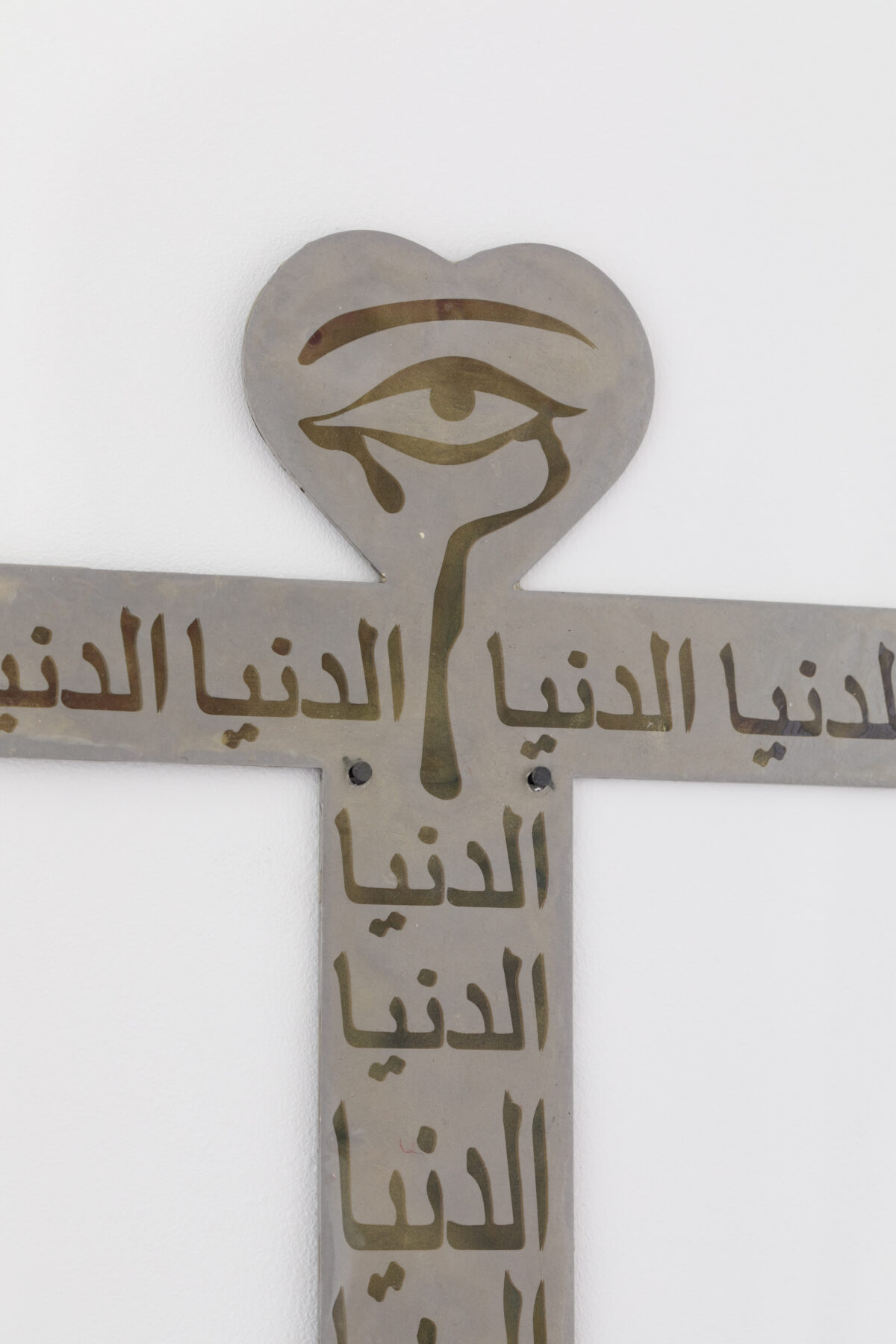
Istifan, like Haraway, rejects absolute interpretations: the woman does not only exist in opposition to the man, as a product of his power, and the new nose does not only owe its existence to the loss of the old one. Such methods of addressing the system destroy the figure just when they are seeking to liberate it. It is the failure to belong to any clear category that results in bodies becoming cyborgs: compilations of superimposed contradictory allegiances that evade any uniform political narrative. This is why, for Haraway, the cyborg is not a technological image, but a figure that enables us to think about the hybrid and confidently rejects naturalisation: neither gender, work, nor origin are determined by nature, rather they are products of history and can therefore be changed. Instead of appearing in Istifan’s work as an obvious tragedy, the reshaped nose is produced just like everything else, but it does not allow itself to be deceived by the latest technical promises of assimilation. And Istifan’s work leaves a further troubling question unanswered: What does it mean to survive through transformation? What is the relationship between self-preservation and self-destruction?
Anyone who spends too much time thinking about Shamiran Istifan’s shiny surfaces is missing the underlying political content and poetry of her investigations. Her quotations are never limited to a single observation, more and more layers of reference open up, some of which are not apparent in the exhibition space. The figure of the gold digger can be seen in terms of its contemporary interpretation in popular culture, and yet the notion is made more complex by Istifan’s Assyrian origins: at the same time, she tells of buried gold in abandoned Assyrian villages – treasure that is still being sought today by newly settled inhabitants, long after the expulsion of its original owners. This leads to a fundamental shift in the activity of ‘gold digging’. Who, in this economy, are the actual gold diggers? Istifan’s practice occupies precisely this interface: between intimacy and geopolitics, between the body and history, between surface and structure. She plays with irony and with a postmodern aesthetic, which the art industry yearns for with the same intensity that society at large yearns for the desirable woman. But her works are never distanced nor disinterested vis-à-vis their source material. Nor does her sense of involvement ever mean that her work is sentimental – and she escapes the patronising accusation of decorative navel-gazing that is levelled at many diaspora positions. Istifan is much more conscious of the visual regime of her performance space, and, just like in a performance, she navigates every one of her productions, each gesture is calculated and each idea incisive. The work is powerful precisely because she moves within the system that she is criticising rather than positioning herself outside it.
text: Moshtari Hilal